How to Lubricate a Garage Door Using Its Maintenance Manual
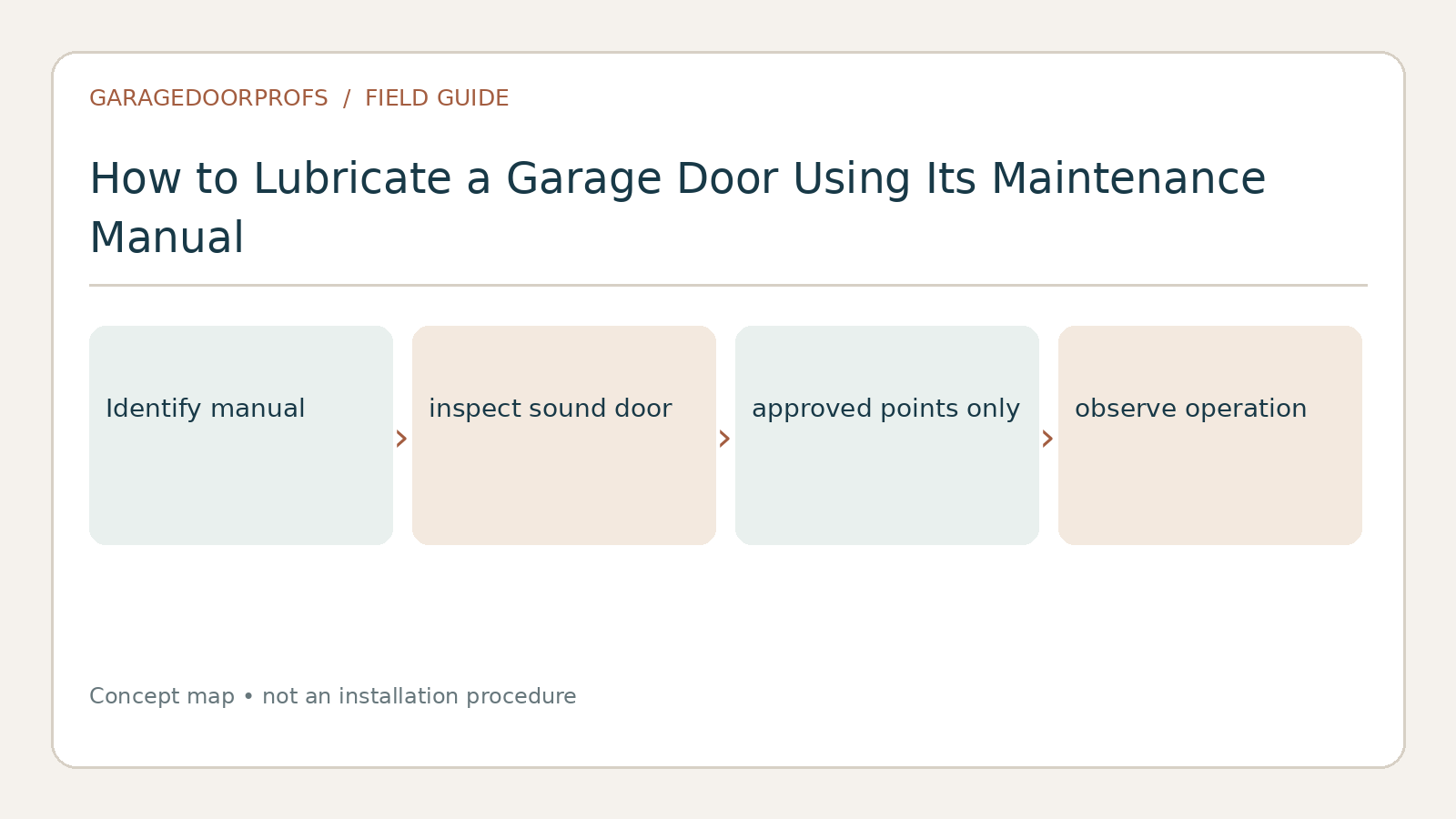
To lubricate a garage door, follow the maintenance manual for your exact door and opener. Use only the product and points the manual names, on a sound door that is stopped and closed, and wipe off any excess. Never grease the door’s side tracks unless the manual says to, and never touch springs, cables, drums, or bottom brackets. If a door is noisy because something is bent, loose, or broken, lubricant will not fix it, so call a technician.
This page is part of the larger garage door maintenance guide, which covers the full routine for homeowners.
When to call a pro. If the door is crooked, scrapes, feels heavy, or you can see a gap in a spring, a frayed or slack cable, or a roller out of its track, stop using it. Do not try to quiet it with lubricant, and do not reach near the spring or cable hardware.
Contents
- Find the right manual
- Inspect before you clean or lubricate
- Where manuals commonly allow lubricant
- Tracks and opener rails follow different rules
- What never to lubricate
- Choosing a product
- Check the result without masking a fault
- Noise lubrication will not fix
- When to hand the job to a technician
- Quick checklist
- In this guide cluster
- DIY or pro
- Where this guidance comes from
- FAQ
- Next step
Find the right manual
The door and the opener often come from different manufacturers, and each has its own maintenance instructions. Look for model labels you can read safely from the floor, plus installation paperwork and receipts. If you cannot find a manual, look it up by the maker and model on the manufacturer’s website instead of following a generic checklist from a video or forum.
If a label is out of reach, do not climb near the hardware to read it. Ask a technician, or check the invoice from the installation. Write down the model numbers and keep them with the manuals.
What to look for in the manual:
- Which points on the door the maker says to lubricate, if any
- The product type it names, or products it warns against
- How often it suggests doing so
- What it says about tracks, rollers, and the opener’s rail or chain
- Any step it says only a trained technician should perform
The manual outranks general advice. Different doors use different rollers, hinges, and bearings, so a step that suits one door may not suit another.
Inspect before you clean or lubricate
Look at the door from the floor with the door closed. You are checking for signs that lubricant is the wrong answer:
- A spring with a gap in the coil, or one that looks stretched or separated
- A cable that is frayed, slack, or off its path
- A roller out of the track, or a visibly bent track
- A bottom bracket that looks loose or pulled away
- A door that hangs unevenly or leaves an uneven gap at the floor
If you see any of these, stop. These parts hold or interact with stored energy. Do not loosen fasteners or touch tensioned parts to stop a noise.
If the door looks sound, note where the noise comes from: a hinge, the track, the opener rail, or the wall. A squeak is not a diagnosis, but where and when it happens helps. A technician should look at grinding, banging, repeated sticking, or a new vibration.
Where manuals commonly allow lubricant
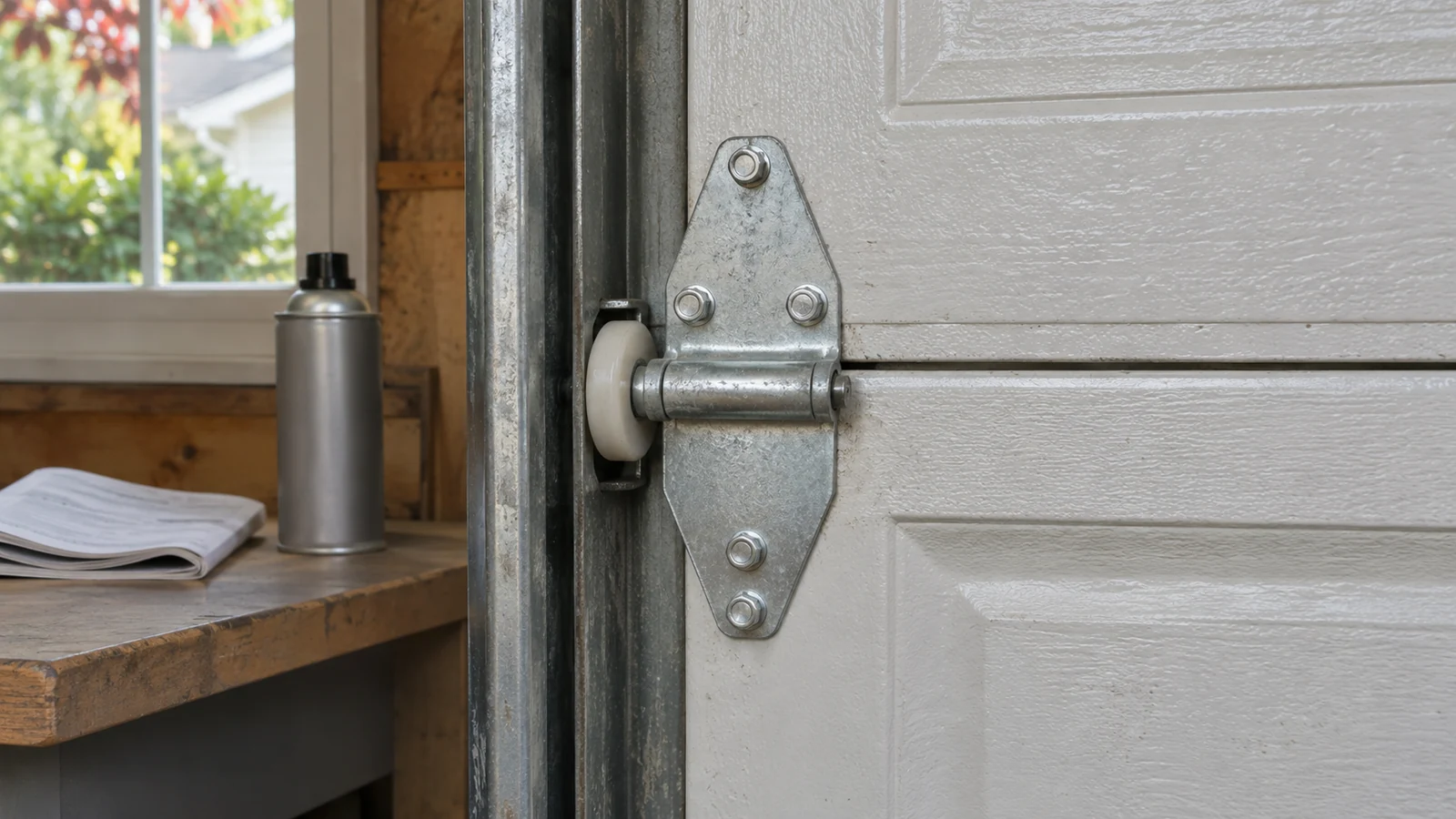
Many door manufacturers describe light lubrication at moving joints that you can see and reach safely from the floor with the door closed and stopped. Typical examples include the hinge pivots between sections and certain roller bearings or stems, plus a lock if there is one. Your manual may name different points or none at all, because some rollers have sealed bearings and some are built so they should not be oiled.
General rules that apply in most cases:
- Use a small amount only at the points the manual lists.
- Work with the door stationary, and keep fingers away from hinges and rollers.
- Do not reach into a spring, a drum, a cable, a track curve, or the opener mechanism.
- Wipe off any excess. Extra lubricant collects dust and grit, and it can reach door finishes, seals, and sensor lenses.
- If a required point is beyond a safe reach from the floor, leave it to a technician.
Do not spray the whole door. The goal is a thin film at a few points, not a coated assembly.
Tracks and opener rails follow different rules
Door tracks. The side tracks guide the rollers. Many manufacturers advise cleaning accessible dirt from the track surface instead of greasing it, because grease holds dust and can gum up the rollers. Follow what your manual says. A bent or loose track needs a professional, not lubricant to help a roller squeeze past the problem. The track cleaning guide explains how to clean without adding grease, and the track guide shows how the parts fit together.
The opener rail. The ceiling rail, chain, belt, or screw belongs to the opener, not the door. Chain, belt, and screw drives have different service guidance. Some manuals specify a lubricant, some limit what you can use, and some leave it to a technician. Read the opener manual. The rail maintenance guide goes into this further.
Do not spray the photo-eye lenses, the wall control, or other electrical parts. Clean sensor lenses only as the manual describes. The sensor cleaning guide covers that.
What never to lubricate
Unless a manual written for your exact system says otherwise, and you are trained to follow it:
- Springs. They hold a large amount of stored energy. Leave them alone.
- Cables and drums. These are part of the counterbalance and are professional-only.
- Bottom brackets. They connect to cable force.
- Track running surfaces. Clean, do not grease.
- Photo-eye lenses and electrical controls. Keep them free of spray.
- Painted or wood finishes. Overspray can mark them. See the cleaning guides for steel, wood, and windows.
If you think a spring or cable is dry, rusty, or noisy, ask a technician to look at it rather than treating it yourself.
Choosing a product
A product labeled “garage door” on the can is not proof it is approved for every point on your door. Check the manual for the type it names, and check that the product is compatible with the finishes, plastic parts, and seals it will touch. Many manuals say a general-purpose penetrating spray is not a long-term lubricant, so do not assume the can in your toolbox is the right one.
Write down the product you used and the date, so you or a technician can see what was applied if a new noise appears later.
Check the result without masking a fault
After maintenance on a sound door, watch normal travel from a safe position. The door should move smoothly, and the opener’s protections should work as documented in its manual. If a sound persists or the movement changes, stop and describe the symptom to a technician. More lubricant is not a diagnosis for a door that is crooked or unusually heavy.
Keep a simple log with the model, the date, the product, and the points you serviced. Use the interval in your manual. If it does not give one, many manufacturers suggest checking and lubricating a few times a year, but your product documentation governs. A universal calendar claim would ignore the different construction of doors and openers.
Noise lubrication will not fix
| What you hear | What it may mean | What to do |
|---|---|---|
| Squeak at a hinge or roller | Dry pivot or bearing | Lubricate only if the manual lists that point |
| Rattling or vibration | Loose hardware or worn parts | Report it; do not tighten tensioned parts |
| Grinding along the track | Dirt, a bent track, or a worn roller | Clean accessible dirt per the manual; call if it persists |
| Scraping at one spot | Misalignment | Stop and call |
| Loud bang, then a heavy or crooked door | Broken spring or cable | Stop use, keep clear, call a pro |
| Opener motor noise or a chattering chain | Opener wear or rail issue | Check the opener manual; call if it persists |
For ideas on a generally quieter door, see the quiet garage door guide.
When to hand the job to a technician
Book service when the manual requires reaching or working near tensioned hardware, when you cannot identify a component, or when the door shows wear, damage, or erratic travel. Describe the noise and where it happens, so the technician can look at the right part.
Ask them to name the product used and the parts treated on the invoice. If they recommend track alignment, a spring, a cable, a drum, or a bottom fixture, ask them to explain the fault and the scope. Keep children and pets clear during any door movement, and never disable a protection device to complete a maintenance task.
Quick checklist
- You found the manuals for both the door and the opener.
- You inspected from the floor and found no damaged spring, cable, roller, track, or bracket.
- You lubricated only the points the manual lists, with the product it names.
- You wiped off the excess and kept lubricant off tracks, sensors, and finishes.
- You watched normal travel afterward and noted any change.
- You logged the product and the date.
- You called a technician for anything involving tensioned parts.
In this guide cluster
- Garage door lubricants: how to check product compatibility.
- Cleaning garage door tracks: why cleaning usually beats adding grease.
- Cleaning sensor lenses: how to keep photo eyes clear.
- Cleaning a steel garage door: care for steel finishes.
- Cleaning a wood garage door: care for wood finishes.
- Cleaning garage door windows: protecting glass and plastic inserts.
- Opener rail maintenance: what to check before lubricating a rail.
- Making a garage door quieter: causes of noise and what helps.
DIY or pro
You can read the manual, inspect from the floor, clean accessible surfaces as it directs, and apply an approved product to the points it lists on a sound door. A technician should handle anything involving springs, cables, drums, bottom brackets, track alignment, or reaching near them.
Safety box. Do not reach into the track curves, the spring area, or the opener mechanism. Do not climb on a ladder next to a moving door. Keep children and pets away while the door is in use, and stop if anything looks damaged.
Where this guidance comes from
This page defers to the door and opener manufacturers’ maintenance instructions, which vary by model, and to DASMA’s homeowner safety tips for garage door systems and openers. It does not describe any adjustment of springs, cables, or tracks. Always follow the manuals for your exact products.
FAQ
Should I grease the tracks?
Do not assume so. Side tracks guide the rollers, and many manuals call for cleaning accessible debris instead of coating the surface, since grease holds dirt. Follow your exact door manual, and have a bent or loose track inspected by a professional.
What lubricant should I buy?
Start with the door and opener manufacturers’ instructions for your exact models. Check the product type they name and its compatibility with finishes, plastic parts, and seals. A general label on a spray can does not show approval for every hinge, roller, or rail.
Can lubrication fix a loud bang?
No. A sudden bang can mean a broken spring or another failed part. Stop using the door and look from a safe place without touching the hardware. If the door is uneven, heavy, or damaged, call a technician. Do not use a lubricant to cover up the symptom.
How often should I lubricate?
Use the interval in your product documentation, and follow any different schedule the installer gives you. Record the date and the product each time. A single interval for every door would ignore how differently doors and openers are built and used.
Next step
- Find the manuals for your door and opener, and note which points and products they name.
- Inspect from the floor, and call a technician if you see a damaged spring, cable, roller, track, or bracket.
- Lubricate only what the manual allows, wipe off the excess, and write down the date and product.