Everything You Need to Know About Garage Door Installation
This garage door installation guide boils down to four moves: measure the opening, get two or three written quotes for the same complete scope, ask your local building department about permits, and let a trained installer fit and test the door. As of November 2026, a new installed single door typically costs about $600 to $1,900 and a double door about $1,000 to $3,000. The fitting itself usually takes a few hours once the door arrives. Removal, springs, cables, and tracks are professional work.
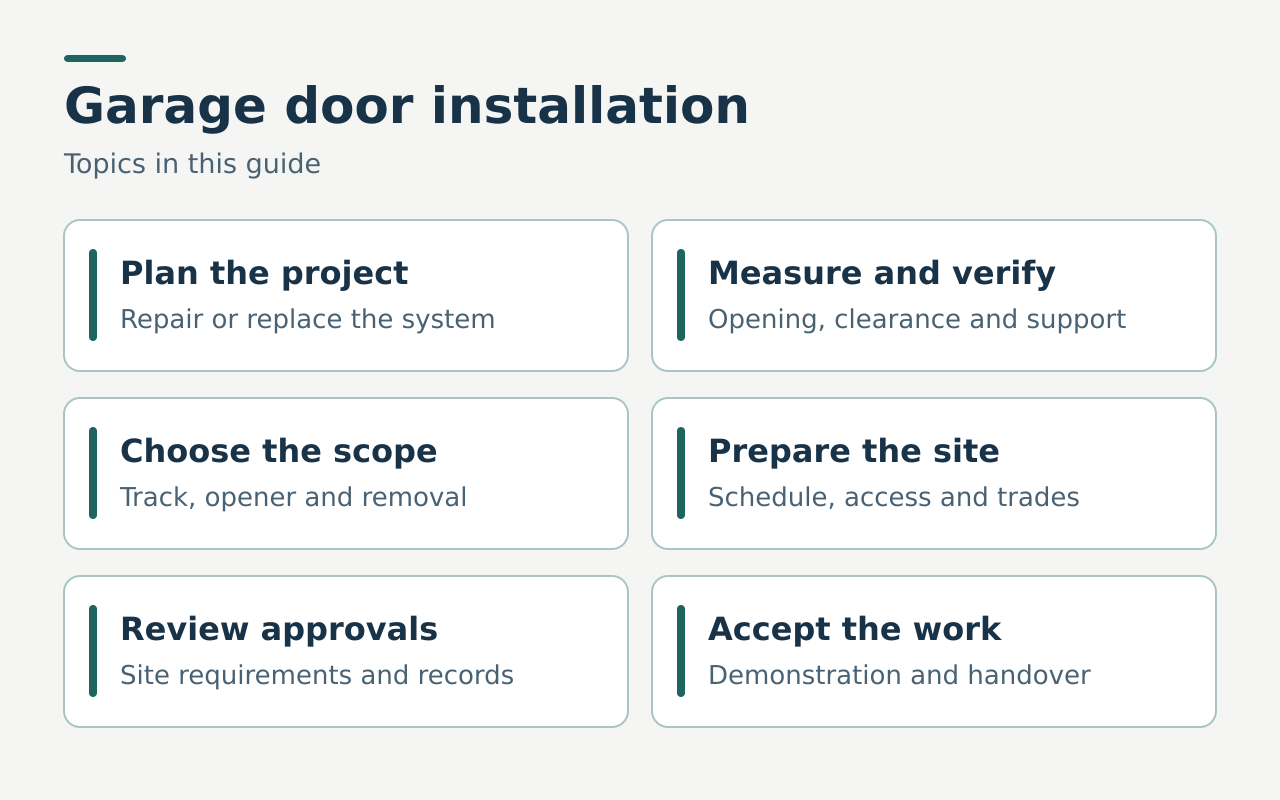
What you’ll learn
- What a replacement involves, how long each stage takes, and what it costs.
- What you can measure yourself and what the installer must verify.
- How to read a quote, check a contractor, and handle permits.
- How to accept the finished work safely.
Contents
- Garage door installation guide: what a replacement involves
- Decide whether the whole door needs replacing
- Measure the opening and check available space
- Plan the replacement timeline
- Prepare the garage for installation day
- Can you keep the current opener?
- Can old tracks be reused with a new door?
- What a garage door installation quote should include
- How long a garage door lasts and when to replace it
- Permits, approvals, and wind ratings
- How to choose a garage door installer
- Low ceilings, uneven floors, and unusual openings
- Common planning problems and what to do next
- DIY or pro: what you can do and what is always pro
- What garage door installation costs
- Installation safety and how to accept the work
- Four real-life installation scenarios
- Where these price ranges come from
- FAQ
- Next step
Garage door installation guide: what a replacement involves
A sectional garage door is a stack of horizontal panels joined by hinges. Wheels called rollers guide the panels along steel tracks at the sides. Springs and lift cables carry most of the door’s weight. An automatic opener, if there is one, moves the balanced door and has its own controls and safety devices. A good installation fits all of that to your opening and ties it into sound framing.
Most replacements move through the same stages. The table shows who does what and roughly how long each stage takes.
| Stage | What happens | Who | Typical time |
|---|---|---|---|
| Assessment and measure | Installer checks the opening, framing, headroom, and existing hardware | Installer | A short visit |
| Order | You approve a written scope; the dealer orders the door | You and the dealer | Days for stock doors; about 1 to 6 weeks for custom |
| Preparation | You clear the garage; other trades finish the opening if needed | You, other trades | Before install day |
| Installation | Old door out, new door, tracks, springs, and opener work in | Installer | A few hours to a full day |
| Handover | Installer demonstrates normal travel and the opener’s safety checks | Installer | Part of install day |
Timing figures come from installer and manufacturer pages and vary by company and door. Ask your own dealer for dates in writing.
Start by writing down why you are replacing the door. A damaged door needs a look at the opening and the guides before anything is ordered. A planned upgrade for quieter running, insulation, or looks can start with the current door’s records. Whatever the reason, put the main goal at the top of each quote request so you can compare the proposals fairly.
Ask who owns each step. The door installer may measure and fit the door, while a different contractor handles framing, trim, or electrical work. Settle the order of work before the door is ordered. If the opening was struck or the wall supports look damaged, keep the door out of use and tell the company.
DASMA, the door industry’s trade group, advises in its homeowner safety guidance that installation and repairs of garage door systems be left to trained technicians.
Decide whether the whole door needs replacing
Replacing one panel or one part can make sense when the rest of the door and its supports are sound and a matching part is still made. Whole-door replacement is usually the better route when several panels are damaged, parts are no longer available, or the door has more wear than one repair can fix.
| Situation | Usually points to |
|---|---|
| One dented or cracked panel, rest of door sound | Panel repair or replacement if a match is available |
| Several damaged panels, bent frame, or twisted sections | Whole-door replacement |
| Discontinued door, no matching panels | Whole-door replacement |
| Door works but is old, drafty, or noisy | Repair first, replacement if the cost approaches a new door |
| Impact damage to framing or tracks | Inspection of the opening before choosing either |
Ask the installer to explain the recommendation part by part. Put the result you want next to each scope, such as “reliable daily use” or “better insulation,” so you can see what each price buys.
If a storm or vehicle caused the damage, ask the installer to look at the framing and track supports before ordering. For an insurance claim, ask your insurer what documentation it needs and what work requires approval first. Arrange immediate safety before paperwork when the door is unstable.
The whole-door repair or replacement guide covers compatible sections, current condition, and when to order a new system.
Measure the opening and check available space
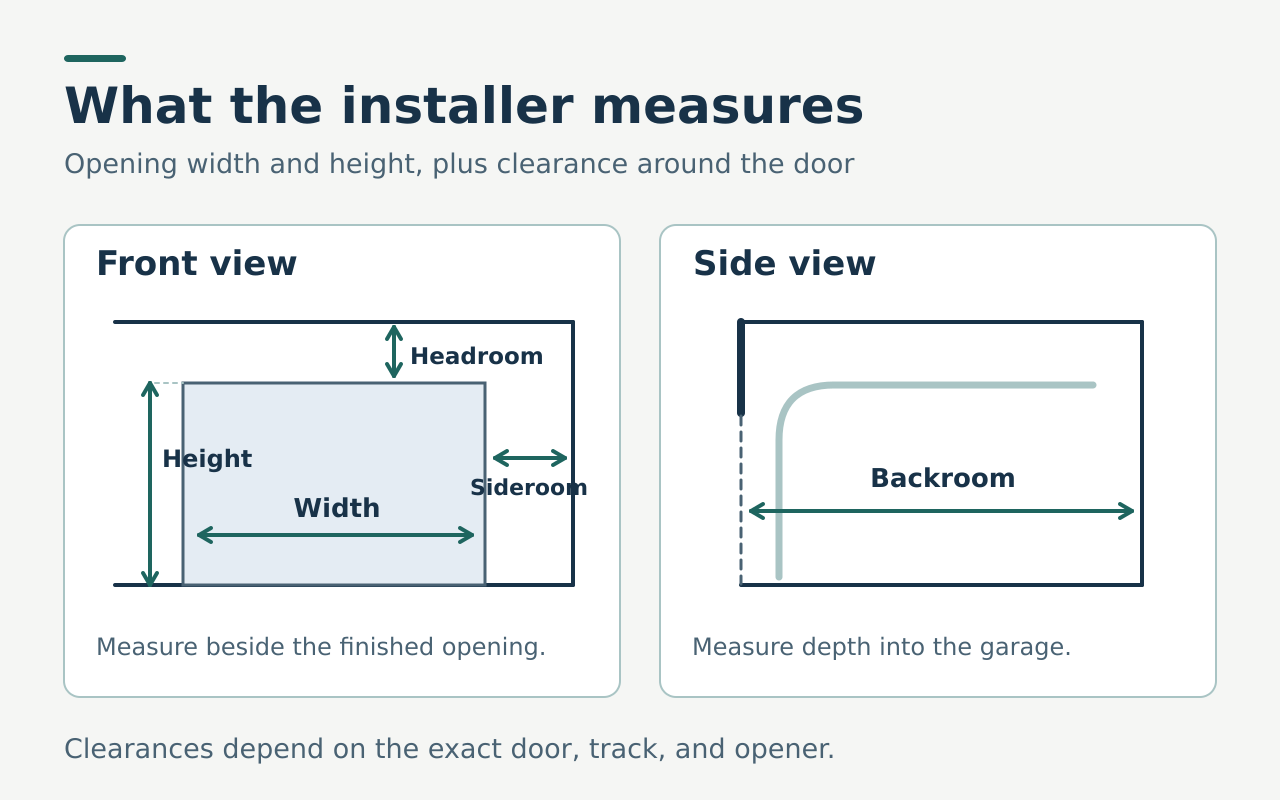
Measure only from the floor and only when it is safe. Record the opening’s width and height and note roughly how much room you see at the sides and overhead. Never reach into or work around a damaged or suspended door. If the door is unstable, share photos taken from a safe distance and any plans or earlier installation records instead.
Three terms matter. Headroom is the clear space above the top of the opening. Sideroom is the space beside it. Backroom is the usable depth along the door’s route into the garage. A closed door can look as if it fits while a beam, light, or utility line limits the track layout. Point out anything near the ceiling, such as lights, storage, or a lift. The installer sets final clearances from the actual model’s documentation.
Note the shape and condition of the opening too: floor slope, a sloped or low ceiling, an obstruction near one side, and any trim changes planned. If another contractor is working on the opening, ask whether the new finish will change the dimensions, and give both trades the same numbers before anything is ordered.
Write measurements in inches or feet and inches, mark where each was taken, and ask who will approve the final opening size. The garage door opening measurement guide gives a floor-level planning sketch and a list of facts the installer should confirm.
Plan the replacement timeline
The schedule starts with a site assessment and a confirmed door configuration. Size, finish, windows, hardware, and any approval paperwork can all affect ordering. Published figures vary by dealer. In-stock doors in standard sizes can often be installed within days of approving a quote, while custom colors, carriage-house styles, and unusual sizes commonly wait one to six weeks for the factory. Wind-rated or special-window doors can take longer.
The installation itself is shorter. Installer pages commonly put a single-door replacement at about 3 to 6 hours and a double door at about 4 to 6 hours, and one manufacturer’s guidance for custom doors says 8 to 10 hours. A full day is a sensible planning figure if the old door must come out, tracks change, or an opener is added.
Build the schedule around what you need back first. If a damaged door is secured and out of use, plan parking and entry through another route while you wait. In a new build, ask which trades must finish before the final measure and when the door can be fitted.
Once the supplier confirms the order, get dates for delivery and installation in writing. Ask whether the crew checks the parts against the order before removing the old door, and what happens if something does not match. The garage door replacement timeline guide breaks the project into milestones from measure to final checks.
Prepare the garage for installation day
Ask the company how much working space it needs, where to park, and where materials can be unloaded. Move vehicles and belongings beforehand only if the old door is safe to operate. If it is damaged or has a vehicle trapped inside, say so before the appointment so the crew can plan how to make it safe.
Plan a route for family members and pets that avoids the work area, and ask which parts of the garage must stay clear during removal and fitting. Keep an adult reachable who can approve changes. If the crew finds damaged framing or the wrong parts arrive, work may pause, so agree in advance how changes will be documented and how the opening will be secured if the job cannot finish that day.
The installation day preparation guide covers clearing the area, confirming access, and coordinating other work.
Can you keep the current opener?
An opener is a separate machine with a motor, drive, controls, and safety devices. Whether it can serve a new door depends on its condition, its supported safety features, and how well it matches the new door’s weight and hardware. Insulated and glass doors are typically heavier than basic single-layer steel, and cost guides note that a heavier door can call for a more powerful opener. Look up the full opener model and tell the installer which controls you want to keep.
Openers also age. Cost guides generally put opener life at 10 to 15 years with average use, so a replacement door is a natural time to ask whether the opener is near the end of its life. As of November 2026, a new opener installed typically costs about $300 to $900, depending on drive type and features.
If the plan keeps the old opener, have the quote say who will reconnect and test it, and whether the sensors, controls, and any battery backup remain supported. If a protection feature has failed or the mounting is damaged, deal with that before the opener goes back into service.
The guide to keeping an opener with a new door covers the questions to ask about fit, condition, and handover.
Can old tracks be reused with a new door?
The track is the pair of metal channels that guide the rollers. Similar-looking curved tracks and a matching opening width do not prove the old tracks suit the new door. Ask whether the new door’s manufacturer allows any existing track to stay in the proposed setup and how the installer will verify support and alignment.
Tell the installer if the tracks were ever struck, bent, or repaired. Check the proposal’s effect on warranty coverage and on any wind-rated configuration, since a rated door is documented as a complete installed system. If two installers differ on whether to keep the tracks, ask both to cite the product documentation and the on-site checks behind their advice.
Do not try to remove, bend, or relocate tracks yourself. They are fastened to a door that carries heavy loads through parts that can look still while the door is closed. The old-track reuse guide explains the questions about profile, support, and approval.
What a garage door installation quote should include
A clear quote names the door, the opening it is for, and whether installation and final setup are included. Use this checklist to compare bids side by side.
| Item | What to look for |
|---|---|
| Door | Model, size, material, insulation, windows, finish, and color code |
| Hardware | Tracks, spring system, brackets, seals, and what is new or reused |
| Opener | New or existing, who connects and tests it |
| Removal | Old door and hardware removal and disposal, listed separately |
| Opening | Who handles trim, framing, or floor work around the door |
| Schedule | Delivery and installation dates, and what causes a delay |
| Changes | How extra work is approved in writing before it starts |
| Payment | Deposit, schedule, and cancellation terms |
| Warranty | What the manufacturer covers and what the installer covers, separately |
| Handover | What the crew will demonstrate and who to call afterward |
The Federal Trade Commission (FTC) advises getting several written estimates that describe the work, materials, completion date, and price. It also says not to pick the lowest bid automatically and to ask why estimates differ. Before you sign, the contract should include the contractor’s name, address, phone number, and license number, start and finish dates, and any verbal promises, with no blank spaces. The FTC also says not to pay the full amount up front and to hold the final payment until you are satisfied. If you sign at home, you typically have three business days to cancel.
If two offers use different materials or hardware, ask each installer to define the difference and what you would see in the finished door. The installation quote checklist and the FTC home improvement guide are good companions for reading bids.
How long a garage door lasts and when to replace it
Published guides generally say a well-kept garage door lasts 15 to 30 years. Angi’s breakdown by material is a useful rule of thumb. Your own door’s life depends on how often it is used, weather exposure, upkeep, and earlier repairs.
| Material | Typical lifespan |
|---|---|
| Steel | 15 to 30 years |
| Aluminum | 15 to 25 years |
| Fiberglass | 20 to 25 years |
| Solid wood | 20 to 30 years |
| Wood composite | 15 to 20 years |
Within steel, guides separate single-layer doors, at around 15 to 20 years, from triple-layer doors, which can reach 25 to 30. Doors used several times a day wear faster than doors used once.
Age alone is not a reason to replace a working door. The better questions are what is worn, what it costs to fix, and whether parts are still made. Ask the installer to assess sections, tracks, mounting points, the spring system, and the opener separately, and to say which parts can be serviced later. If a door has an unusual size or finish, ask how you would identify matching parts down the road. The garage door service life guide covers wear, parts availability, and environment in more detail.
Permits, approvals, and wind ratings
Contact your local building department and ask whether a permit, product approval, or inspection applies to your project. Describe the scope: a straight door replacement, changes to the opening or supports, or added electrical work. Then ask the installer who will apply for any permit and handle required inspections. The FTC lists a contractor who asks you to get the permits as a red flag, so make sure the written scope says who is responsible.
In areas with wind requirements, ask which door configuration carries the relevant approval. A label helps only when it matches the installed size, glass, reinforcement, hardware, and mounting. Ask whether a different window option or hardware package is covered by the same approval, and which DASMA technical data sheets the installer relies on; TDS-181 is one reference to bring to that conversation.
If the garage is part of a larger project, bring the other trades’ drawings to the door measure and record which dimensions are finished and which are rough. If a homeowners association has rules on appearance, take the exact model and finish to that conversation.
The garage door permits guide helps you prepare questions for the building department.
How to choose a garage door installer
Look for a company that can describe installing the type of door you want and name the people who will do it. Verify a license if your state or city requires one, ask for proof of insurance, and confirm the written estimate names the company and gives a contact you can check. The FTC also advises asking for recommendations from people you trust and checking complaints with your local consumer protection office.
The International Door Association (IDA), a trade association, runs a dealer locator on its website where you can search by zip code. Membership can be a starting point for your list, but the IDA page does not explain what membership requires, so treat it like any other credential and verify the rest yourself.
A technician who services existing openers has a different job from a company that measures, supplies, and fits a new door. Decide who owns compatibility, documentation, and handover. Ask for references from jobs like yours and put the same questions to every company in writing. Avoid approving scope changes based on a quick conversation at your door.
The installer hiring guide covers responsibility, documents, and what to check before final payment.
Low ceilings, uneven floors, and unusual openings
If a ceiling slopes or a beam sits near the opening, tell the installer how you use the space above the door. Some track arrangements change where the door travels or how much side room it needs, so the layout should be chosen before the track and opener are ordered.
For an uneven floor, note where daylight shows under the closed door or where water collects. Opening measurements and floor condition are separate facts. Ask what the bottom seal can accommodate and whether another trade should correct the floor.
Older garages can have unusual framing, a low lintel, several layers of trim, or repairs hidden behind it. Tell the company if you have construction records, and agree on what happens if the crew finds conditions that prevent mounting the approved hardware. For a narrow or very tall opening, ask about clear width with the door open and the space needed above for the track. Compare the usable opening after installation with the measured one, and get final figures from the installer.
Common planning problems and what to do next
| What you find | Likely planning issue | What you can do |
|---|---|---|
| Low beam near the front | Track and opener clearance | Show it to the installer and ask for a confirmed layout |
| Gap or slope at the floor | Opening and seal fit | Note where it is and ask for a site measure |
| Old track looks shifted or bent | Damage to the guide or its support | Keep the door out of use and arrange an assessment |
| Newer opener already in the garage | May suit the new door | Share the model and ask for a compatibility check |
| New trim or framing on the opening | Finished size may differ from records | Coordinate the final measure with other trades |
| Window or wind approval matters | Configuration needs matching documents | Confirm the requirement and the version on the quote |
| Garage door is the only way out | Access during installation | Plan an alternate route with the household and installer |
| Delivered door looks different | Wrong package or an unapproved substitution | Compare it to the order before work starts and get a written fix |
DIY or pro: what you can do and what is always pro
When to call a pro. Leave removal, installation, and adjustment of the full door system to a trained technician. If a door is unstable, visibly out of line, or has damaged springs, cables, or supports, stop using it and keep clear. Verify any locally required license before hiring.
Here is the dividing line.
| You can | A pro should |
|---|---|
| Gather manuals, receipts, and photos | Do the final site measure |
| Take rough floor-level measurements on a sound door | Remove the old door and hardware |
| Clear the garage and plan parking | Install tracks, springs, cables, and the door |
| Compare written quotes | Set door balance and travel |
| Ask the building department about permits | Connect and test the opener’s safety features |
| Check the finished work from a clear spot | Fix anything that fails a check |
A single garage door typically weighs 125 to 250 pounds, and a double door up to 500 pounds, according to Angi. Springs hold that weight under tension. One guide puts professional installation labor at $150 to $500 when the door is bought separately, which is small next to the risk of getting hurt. Skipping the installer is the one saving this guide does not recommend.
What garage door installation costs
The table gives approximate national ranges in U.S. dollars, as of November 2026. They combine door and labor unless noted. Treat them as a way to spot a quote far outside normal, not as a price to expect. Costs vary by region, door model, and contractor, so get two or three written quotes. The garage door costs guide is the full budgeting reference.
| Item | Typical range | What pushes it up |
|---|---|---|
| New single door, installed | $600 to $1,900 | Size, insulation, windows, wind rating |
| New double door, installed | $1,000 to $3,000 | Wider span, heavier door, glass |
| Insulated single door (door only) | About $600 to $1,400+ | Insulation thickness and layers |
| Wood, composite, or glass door | About $1,000 to $8,000 | Material, size, custom finish |
| Installation labor, door bought separately | About $150 to $500 | Door size, site conditions, removal |
| New opener, installed | $300 to $900 | Drive type, features, battery backup |
| Removal and disposal | Ask | Often listed separately or bundled |
| Permit | Varies by city | Check with the building department |
A few figures behind the table. This Old House puts a new garage door at $1,151 to $1,869, with about $1,400 as the average for a standard installation. Lawnstarter’s 2026 data puts the average double-door replacement at about $2,100, in a range of $910 to $3,290. Liberty Home Guard lists about $600 to $1,300 for a 9 by 7 door and $1,000 to $2,300 for a 16 by 7 door. Glass doors run higher, with This Old House citing $2,500 to $8,000.
What moves your quote most: door size, material, insulation, windows, and whether the opener is replaced. Site work counts too. Framing repairs, a floor that needs correcting, and new wiring are often priced separately or by another trade. Ask for those items to be listed or marked as pending if they cannot be confirmed on the first visit, and ask which company is responsible for each.
Installation safety and how to accept the work
Keep people and pets out of the work area through removal and fitting, and follow the crew’s instructions about doors, vehicles, and power. Do not enter the work area to check progress.
At handover, ask the installer to show a normal opening and closing cycle from a clear position. Have the technician demonstrate the opener’s reversal and photo-eye checks using the opener manual, and learn where the manual explains how to run those tests on a working door. Learn how the emergency release works, which controls are active, and how to get in and out during an outage.
Compare the finished work with the written scope: color, options, hardware, removal, and any approved changes. Get the installation record and owner documents for the exact models. If anything is outstanding, write down what remains, the current condition, and the next action, and ask which operations the installer confirms as safe in the meantime. DASMA’s homeowner safety tips are a good companion read for how the door and opener work together.
Save the paperwork somewhere you can find it: purchase and installation records, manuals, any permit or approval, the model and finish codes, and the contact for warranty service.
Four real-life installation scenarios
These are composite examples, not case studies. Prices and details vary.
A bumped panel. A driver backs into the door and cracks one panel. The homeowner keeps the door closed and calls for quotes. One company offers a single panel; another says the door is discontinued and proposes a whole new door. The homeowner asks each to put the reason and the matching-part availability in writing. A panel match exists, so the repair is cheaper than a new door, and the installer also checks the tracks for damage before leaving.
Two bids, two measurements. One installer measured the finished opening and the other the rough framing. The prices differ by several hundred dollars. The homeowner asks both to record where and how they measured. The difference came from trim that was about to be added, so the homeowner has the second installer re-measure after the trim goes on, and orders only then.
A heavier door on an older opener. A family upgrades to an insulated door with windows. The installer says the 12-year-old opener may struggle with the extra weight and is near the end of its normal life. The quote is revised to include a new opener, adding a few hundred dollars. The family compares the revised total with the original, confirms the opener’s safety features are included, and approves it.
The wrong door on delivery day. The crew unpacks a door with a different window layout from the order. The homeowner compares it with the signed quote, and the crew agrees to stop. The old door stays in place and the opening is secured while the dealer reorders. The homeowner gets a new written date and confirms there is no extra charge before the work resumes.
Where these price ranges come from
The ranges in this guide were compiled in November 2026 from published national cost guides. They are not local quotes. Sources included This Old House’s garage door cost guide, Lawnstarter’s double-door replacement guide, Liberty Home Guard’s replacement cost guide, HomeGuide’s garage door price guide, and TaskRabbit’s replacement cost guide for the labor range. Opener costs came from HomeGuide’s opener pages. Lifespan ranges came from Angi’s lifespan breakdown by material. Installation times and lead times come from installer and manufacturer pages and vary by company.
Contractor guidance comes from the FTC’s home improvement guide and the IDA dealer locator. Where sources disagreed, the ranges here were widened to cover most of them. Confirm everything with written local quotes.
FAQ
How long does a garage door installation take?
Installer pages commonly say 3 to 6 hours for a single or double door, longer for custom doors or when tracks and an opener change. The door itself may take days for stock sizes or up to several weeks for a custom order. Ask your installer for both dates in writing.
Is it cheaper to install a garage door myself?
You may save the labor charge, which one guide puts at $150 to $500. But a single door weighs about 125 to 250 pounds, and springs hold it under tension. The savings are small next to the injury and rework risk, so hire a trained installer.
Do I need a permit to replace a garage door?
It depends on your city and the scope. Ask your local building department, describing whether you are replacing only the door or changing the opening or wiring. Then get the written scope to say who applies for any permit and who handles inspections.
Should I replace the opener with the door?
Not always. A heavier insulated door can call for more lifting power, and openers typically last 10 to 15 years. Ask the installer to assess the existing opener’s condition, compatibility, and safety features. As of November 2026, a new installed opener typically costs about $300 to $900.
How many quotes should I get?
Two or three written quotes built on the same scope. Give each company the same measurements, goals, and photos, then compare door, hardware, removal, warranty, and handover line by line. The FTC advises asking why estimates differ instead of picking the lowest.
Can I reuse my old tracks?
Only if the new door’s manufacturer allows it and the installer verifies support and alignment. Similar-looking tracks do not prove a fit. Ask for the reasoning in writing, and note that it can affect warranty coverage or a wind-rated configuration.
What should I check before I pay the final bill?
Compare the finished door with the written scope, and ask for a demonstration of normal travel and the opener’s safety checks. Collect the model details, installation record, and warranty contact. The FTC advises holding the final payment until you are satisfied with the work.
Next step
- Write down your goal, your door’s current condition, and the rough opening width and height, measured from the floor.
- Request two or three written quotes for the same complete scope, and ask your building department about permits.
- Use this garage door installation guide to plan the handover: operating instructions, safety checks, and equipment records.