How to Choose a Garage Door Opener: A Buyer’s Checklist
To choose a garage door opener, start with the door, not the motor: confirm the door is balanced and in good shape, then match the drive type, noise level, controls, backup power, and safety features to how you use the garage. As of November 2026, a new opener installed typically costs about $300 to $900. Compare written quotes for the same model and scope, and have a technician set up and test the safety features.
This page is part of the larger garage door opener guide, which covers how the whole system works.
When to call a pro. If the door is heavy, crooked, scraping, or has a broken spring or cable, stop using it and have it repaired before buying an opener. A new motor cannot fix a door that is out of balance, and forcing it can be dangerous.
Contents
- Start with the door
- Choose a drive type
- Check space and mounting
- Pick controls and connected features
- Plan for power outages
- Safety features to confirm
- What an opener costs
- Quick checklist
- In this guide cluster
- DIY or pro
- Where these price ranges come from
- FAQ
- Next step
Start with the door
An opener only moves the door. The springs do the lifting: they counterbalance the door’s weight so a person can raise it by hand when the opener is disconnected. If the springs, cables, or tracks are worn or damaged, the opener ends up working far harder than it was built to, and the door can behave unpredictably.
Before you shop, look at the door from the floor and write down what you see:
- Does it hang level when closed, with an even gap along the bottom?
- Does it travel smoothly, or does it jerk, scrape, or shake?
- Do you hear grinding, popping, or banging?
- Is any spring, cable, roller, or track visibly damaged or out of place?
A “yes” to the last two means a repair comes first. A strong new motor on a bad door can mask the fault for a while and then fail, or leave the door unsafe. Cost guides typically put a garage door opener’s life at 10 to 15 years, so if yours is near that age and the door is sound, a replacement is a reasonable plan. If the door is the problem, fix it first.
Also record the door’s type and size, and whether it is heavy: insulated, wood, or glass doors weigh more than a basic single-layer steel door. Angi puts a typical single door at about 125 to 250 pounds and a double door at up to about 500. Give those details to every installer so each quote is for the same job.
Choose a drive type
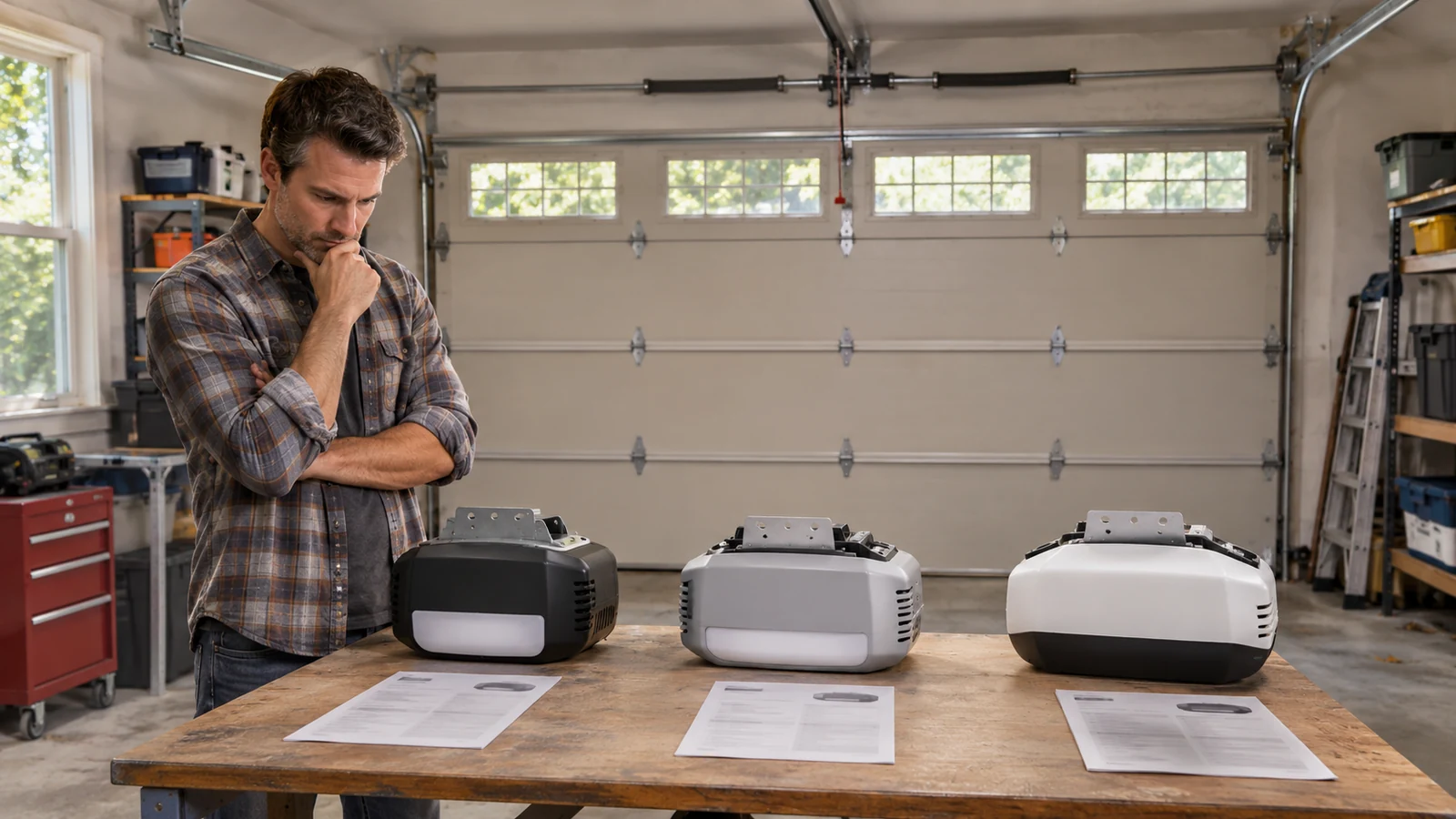
The drive is the mechanism that connects the motor to the door. The common types are:
| Drive | How it works | Usually known for |
|---|---|---|
| Chain | A metal chain pulls a trolley along a rail | Familiar design, often a lower price, more noise |
| Belt | A reinforced belt does the same job | Generally quieter than chain |
| Screw | A threaded rod turns to move the trolley | Fewer moving parts; check each maker’s notes on noise and temperature |
| Wall-mounted (jackshaft) | A motor on the wall beside the door turns the torsion shaft | No ceiling rail, which can help with low ceilings or a garage used for storage |
Prices and noise differ by model, so use the table as a starting point, not a ranking. Ask for each unit’s published specifications, including approved door size and weight limits.
If a bedroom sits above or beside the garage, tell the installer. Noise travels through the structure as well as the motor, so worn rollers, loose mounting, and an unbalanced door all add to it. A quieter drive helps, but it does not replace fixing those causes. The quiet opener guide covers this in more detail, and the chain vs belt guide compares the two most common choices.
Check space and mounting
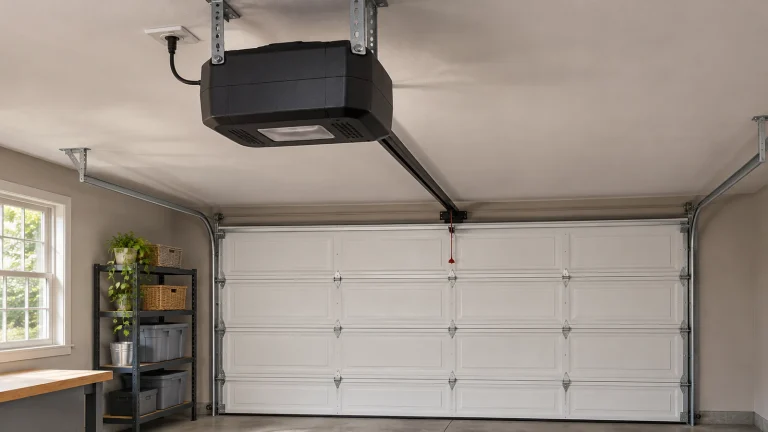
A ceiling-mounted opener needs a rail, a motor head, and solid ceiling or header support, plus room for the door to travel. Look at your garage for anything that could get in the way: lights, storage racks, a ceiling beam, a bedroom wall, or a car lift. A wall-mounted unit needs clear space beside the door and a door set up for it.
Do not climb a ladder next to the door’s springs or tracks to measure. Describe the obstacles and let the installer check clearances against the maker’s installation instructions. A wall-mount model is only an option when the door and shaft arrangement are approved for it, so ask the installer to confirm before you compare prices. The wall-mount compatibility checklist and the wall-mount vs ceiling-mount guide explain what to ask.
Pick controls and connected features
List who needs access: household remotes, a wall control, an exterior keypad, a car-integrated button, or a phone app. Check that each accessory is listed as compatible with the exact opener model. A “universal” label on the box is not proof that a particular unit supports it.
Ask how a lost remote can be removed from the system. Ask who sets up and tests the keypad.
Wi-Fi is optional on many models. It can send alerts and let you check the door’s status, but it needs a dependable signal in the garage and usually an account. Decide whether remote status and alerts solve a real problem for your household, and check what the opener does when the internet is down. The Wi-Fi opener guide goes through the questions to ask.
Plan for power outages
If you rely on the garage for the way in and out of your home, ask each bidder what happens in a power cut. Some models include battery backup, some offer it as an option, and others have none. Ask how long it is meant to run, how it is maintained, and what it covers.
Every opener also has a manual release so a sound, closed door can be operated by hand. Ask the installer to show you where it is and how it works on your model, using the owner’s manual. Do not pull the release on a door with a broken spring, a loose cable, or a door that is crooked or partly open, because it can drop or move suddenly.
Safety features to confirm
Modern openers are built to the UL 325 safety standard and include protection against the door closing on a person or object. Two features matter most:
- Photo-eye sensors near the floor on each side of the door. They watch the closing path.
- Automatic reversal if the door meets an obstacle while closing.
Ask the installer to demonstrate both, following the opener manual, on a working door while you are present. Never disconnect or bypass a sensor to get a door moving, and never tape over a lens. If a test fails, stop automatic use and call for service. DASMA’s homeowner safety tips for openers are a good reference for questions to ask.
Also ask for the model’s approved door size and weight limits and its required hardware. Do not buy on a horsepower number alone. Makers describe motor power differently, and the horsepower comparison guide explains why a figure on a box does not tell you how well a unit suits your door. If your door is heavy or oversized, read the heavy door guide and the oversized door guide.
What an opener costs
As of November 2026, published cost guides put a new opener, installed, at about $300 to $900 depending on the drive type, features, and how much labor the job takes. That range matches the figure in our costs guide. It does not include repairs to the door itself, new electrical work, or a ceiling that needs reinforcing, which are often priced separately.
Ask each bidder to put these items on separate lines:
- The exact opener model and drive type
- Rail or shaft parts, and what is reused
- Sensors, wall control, and how many remotes
- Power arrangement and any electrical work
- Labor, haul-away of the old unit, and any door repair
- Warranty on parts and labor, and who handles a callback
If one quote reuses the old rail and another includes a new one, the totals are not comparable. The rail reuse question is covered below.
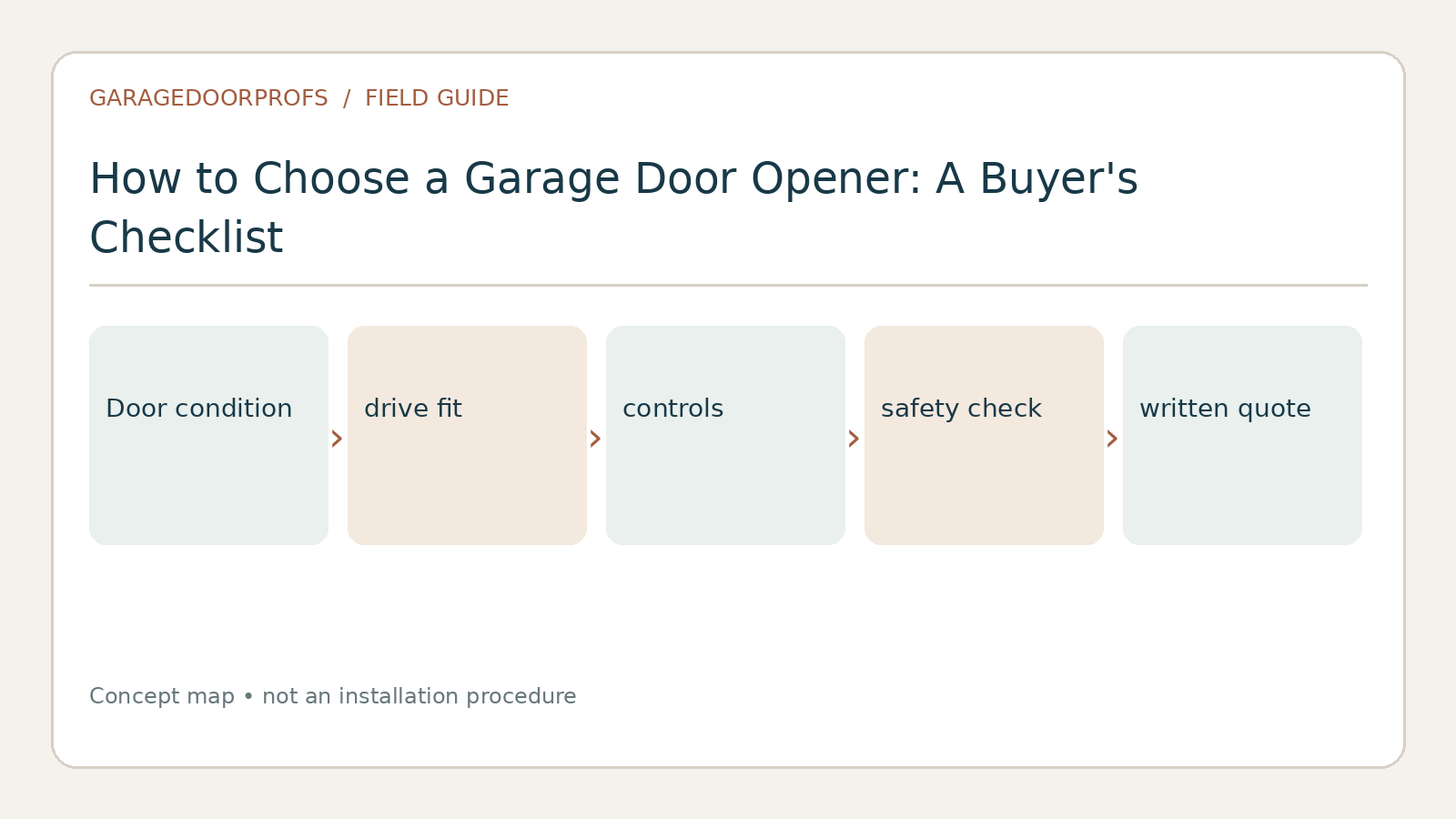
Quick checklist
- The door is balanced, travels smoothly, and has no damaged spring, cable, roller, or track.
- You know the door’s type, size, and rough weight.
- You have chosen a drive type with noise and space in mind.
- Each accessory is confirmed as compatible with the exact opener model.
- You know what happens in a power outage and where the manual release is.
- The installer will demonstrate the reversal and sensor tests with you present.
- You have written quotes for the same scope, with the model number on each.
In this guide cluster
- Chain vs belt garage door openers: how the two most common drives compare on noise, price, and upkeep.
- Screw drive garage door openers: what a screw drive offers and where it falls short.
- Wall-mount garage door openers: a compatibility checklist for jackshaft units.
- Wall-mount vs ceiling-mount openers: which mounting suits which garage.
- AC vs DC opener motors: what the motor type changes in everyday use.
- Opener horsepower: how to read and compare power ratings.
- Opener for a heavy door: matching an opener to a heavier door.
- Opener for an oversized door: what changes with tall or wide openings.
- Quiet openers for a garage below a bedroom: cutting noise where it matters most.
- Direct drive openers: how direct drive works and what to ask.
- Choosing a Wi-Fi opener: app, alerts, and what happens without internet.
- Opener rail maintenance: what to check before you lubricate a rail.
- Opener stops after several cycles: why a unit may shut off after repeated use.
DIY or pro
You can do the preparation: note the door’s condition from the floor, list the controls your household needs, collect model labels you can read safely, and compare written quotes. Installation involves ceiling or wall mounting, electrical connection, and setup of the door’s travel and safety features. Most homeowners are better served by a trained installer, especially because the opener has to be matched to a door whose springs and cables hold dangerous tension.
Safety box. Do not adjust springs, cables, drums, or bottom brackets while installing or “fixing” a door for a new opener. If the door will not stay put when disconnected, or feels heavy, that is a balance problem for a technician. Keep children and pets away from the controls and the door’s path.
Where these price ranges come from
The opener range ($300 to $900 installed) was compiled in November 2026 from published national cost guides and is not a local quote. The opener lifespan (10 to 15 years) and typical door weights come from Angi’s garage door guidance. Safety references come from DASMA’s homeowner safety tips for garage door openers. Costs vary by region, so get written local quotes.
FAQ
Which opener drive is best?
It depends on your door, space, and noise priorities. Belt drives are generally quieter, chain drives often cost less, and wall-mounted units free ceiling space. Compare each model’s approved door limits and installation requirements, and ask the installer to explain why the choice fits your door.
Does a more powerful opener fix a heavy door?
No. The springs carry the door’s weight, so a door that feels heavy or sticks needs a professional assessment. A stronger motor can hide a mechanical fault for a while and then fail or create an unsafe situation. Repair the door before choosing a motor.
Is Wi-Fi necessary on an opener?
For many households it is optional. Decide whether alerts and remote status solve a real need, then check that the exact model supports them and still works locally if your internet drops. Read the product documentation on account controls before you buy.
Can I reuse my old rail?
Do not assume so. The rail, trolley, and mounting must match the new model’s installation instructions. Ask the installer to list every reused part in the quote and show the manufacturer’s basis for compatibility. Otherwise, a price comparison is not like for like.
Next step
- Check the door first: note any heaviness, scraping, or damaged parts, and get repairs done before you buy.
- Write down your drive, noise, control, and backup-power needs, then request two or three written quotes with the exact model on each.
- Ask the installer to demonstrate the reversal and sensor tests, using the manual, before you pay the final bill.