Garage Door Styles and Materials: A Homeowner’s Guide
Garage door styles and materials come down to two separate choices: how the door opens and looks (the style), and what it is made of (the material). For most homes the practical default is an insulated steel sectional door, which published guides put at roughly $600 to $1,900 installed for a single door as of November 2026. Wood, aluminum, fiberglass, composite, and glass cost more or less depending on the finish, and each ages differently. Installation is professional work, so use this guide to decide what to ask for.
What you’ll learn
- How sectional, roll-up, and tilt-up doors differ.
- How panel designs change the look of the house.
- What each material does well, where it struggles, and about what it costs.
- How to read insulation claims, including R-value and U-factor.
- Which choices to settle before you request quotes.
Contents
- Garage door styles and materials: the basics
- Door types by how they open
- Panel designs and the look of the house
- Steel doors
- Wood doors
- Aluminum doors
- Fiberglass doors
- Wood composite doors
- Glass and full-view doors
- Insulation, R-value, and U-factor
- Windows in a garage door
- Colors and finishes
- Climate, weight, and upkeep
- Materials compared side by side
- Brands and how to compare them
- Common choice problems and what to do next
- DIY or pro: what you can do and what is always pro
- What garage doors cost
- Safety when changing a door
- Four real-life choice scenarios
- Where these price ranges come from
- FAQ
- Next step
Garage door styles and materials: the basics
A garage door is the largest moving part of most homes, and it often covers a big share of the street-facing wall. That is why the choice feels bigger than “a door.” It also carries real weight and tension, so the style, the material, and the hardware have to work together.
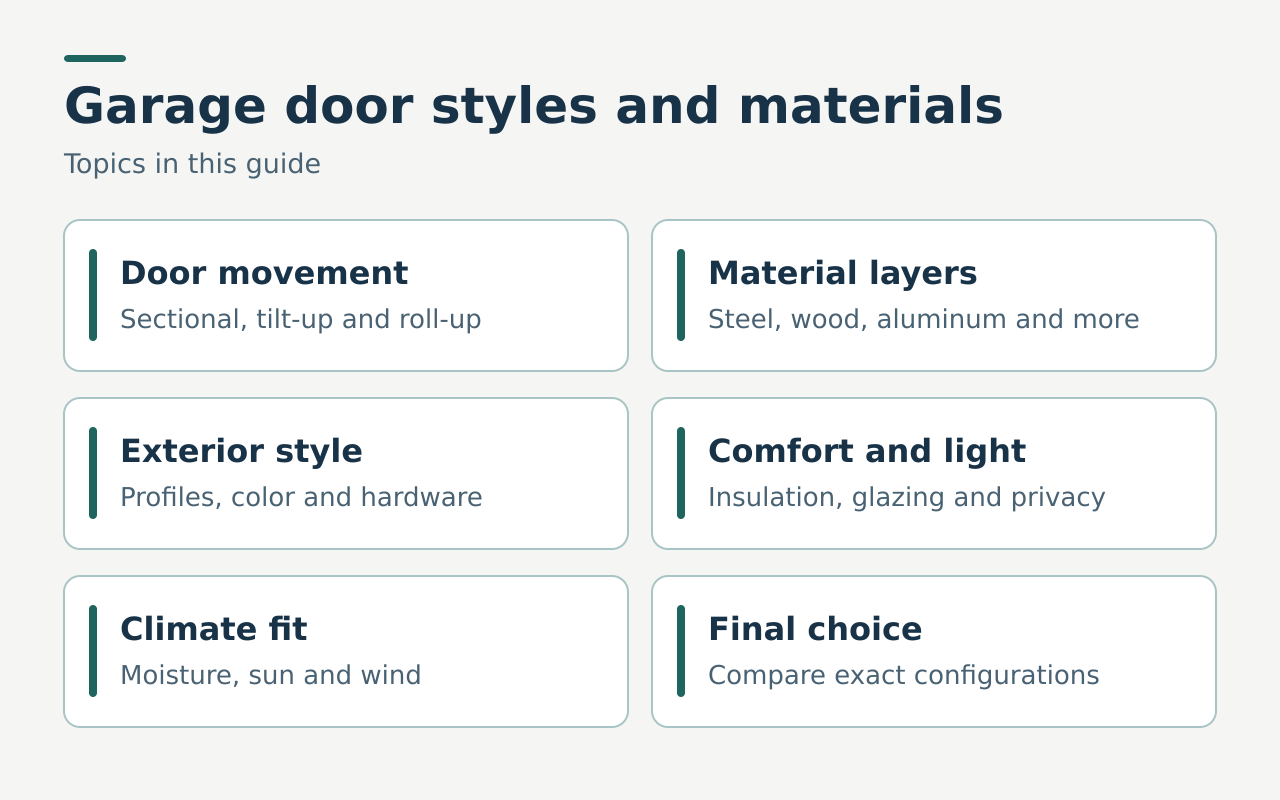
Think of the decision as five layers:
- Type. How the door moves: sectional, roll-up, or tilt-up.
- Design. The panel pattern: flush, raised, carriage house, or full-view.
- Material. Steel, wood, aluminum, fiberglass, composite, or glass.
- Performance. Insulation, windows, seals, and any wind rating your area requires.
- Finish. Color, texture, and hardware.
Most homeowners start with the finish, since it is the part you see. Start with performance and type instead. A door that is wrong for the opening, the climate, or the opener is expensive to fix after it is ordered. Finish options usually come last because most designs come in several colors.
Garage door manufacturers and dealers use their own product names, so two doors that look similar can differ in thickness, insulation, and hardware. Ask each dealer to name the model, the material and its thickness, the insulation type, and the warranty terms in writing. Then compare the quotes side by side using the same list.
If the garage is attached to living space, a bedroom above it, or a workshop, the performance layer deserves more weight. If it is a detached storage building, the budget may matter more than insulation. Write down which group you are in before you shop.
Door types by how they open
Most homes have a sectional door. Others have roll-up or tilt-up doors, usually on older homes, detached buildings, or commercial-style garages.
| Type | How it works | Where it is common | Main trade-off |
|---|---|---|---|
| Sectional | Horizontal panels hinge together and roll up tracks to rest overhead | Most modern homes | Needs headroom and track space |
| Roll-up | Slats coil around a drum above the opening | Storage units, commercial buildings, some tight garages | Often narrower style range and a different sound |
| Tilt-up | One solid panel tilts and swings up and out | Older homes and some custom work | Swings outward, so the driveway apron must be clear |
A sectional door stays close to the ceiling when open, and the driveway in front stays free. That is the main reason it became the standard. The panels can be flush, raised, or carriage-style, and they can carry insulation and windows.
A roll-up door suits garages with little headroom or special needs, though its look is less varied. A tilt-up door is a single solid panel, so it can be a good match for a traditional wood design on an older home, but replacements and parts can be harder to find.
The sectional vs tilt-up guide and the roll-up vs sectional guide go deeper on how each type affects clearance, upkeep, and parts.
Before you fall for a type, tell the installer about your headroom, sideroom, and ceiling. An opening that works for one type may not work for another. Changing the type can mean new framing, new hardware, and sometimes a different opener, so it adds to the budget and the schedule.
Panel designs and the look of the house
Panel design sets the character of the door. The names vary by maker, but the main families are consistent.
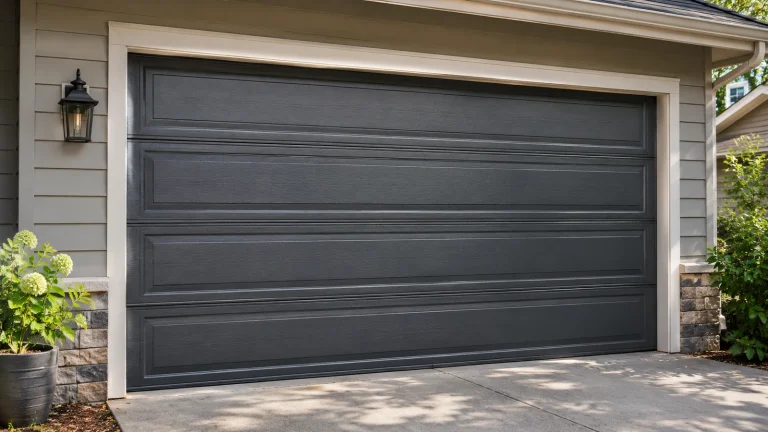
Flush panels. A flat, smooth face with grooves between the sections. They suit modern and minimalist homes and are easy to keep clean because there are fewer edges where dust collects.
Raised panels. Rectangular panels pressed or built up from the surface, with a shadow line. This is the traditional look found on many suburban homes. Long raised panels and short raised panels create different proportions, so look at both against your house.
Carriage house. Designed to look like swinging barn-style doors, with decorative hardware, overlays, and often windows, but still opens like a sectional on tracks. Carriage-style looks are popular on cottage, farmhouse, and craftsman homes.
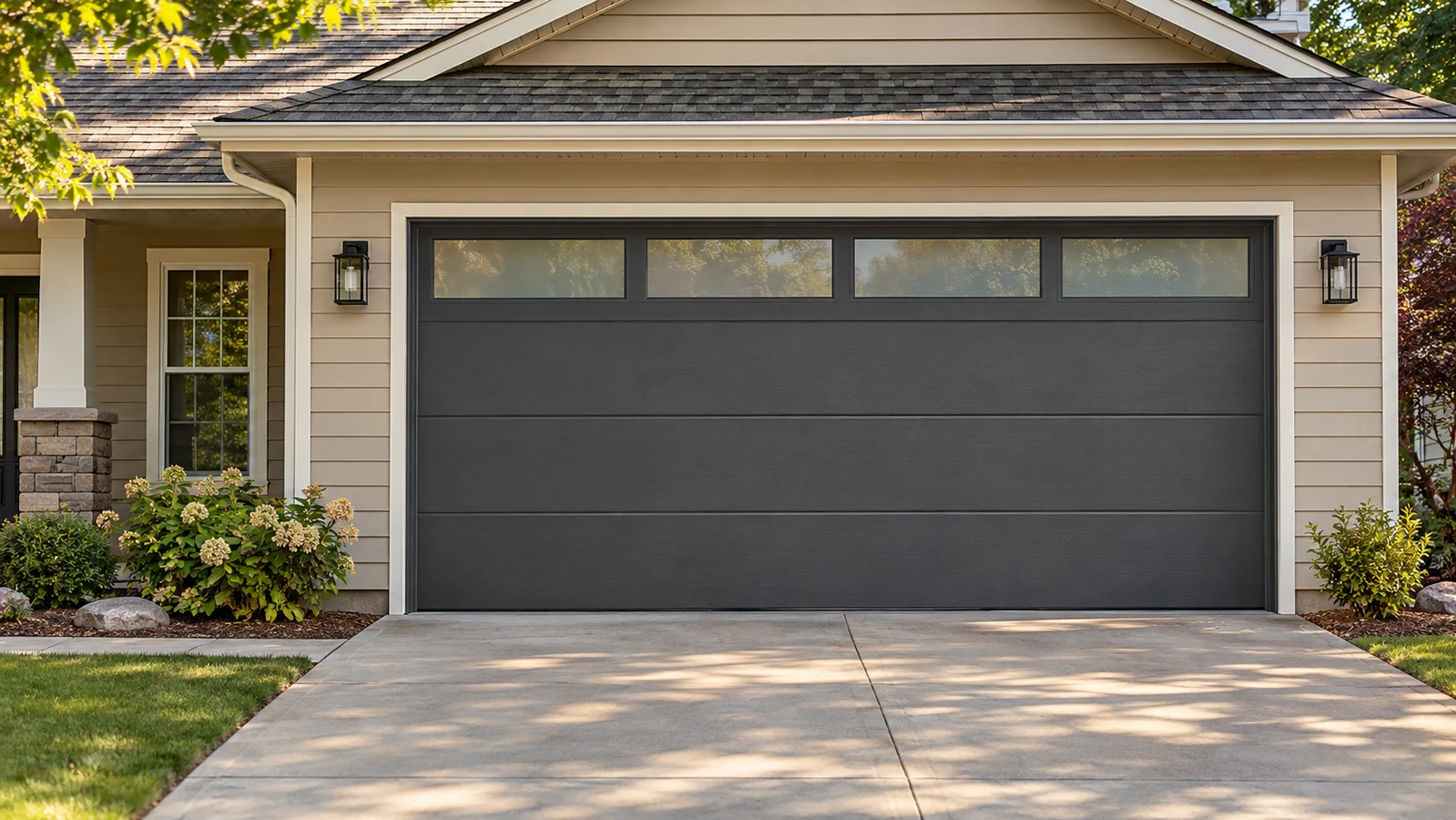
Modern and full-view. Clean lines, narrow stiles, and often wide glass panels set in an aluminum frame. They bring in light and suit contemporary architecture.
| Design | Good match | Things to check |
|---|---|---|
| Flush | Modern, minimalist, ranch | Smooth finishes show dents more easily |
| Raised panel | Traditional, colonial, suburban | Pattern and depth differ by model |
| Carriage house | Craftsman, farmhouse, cottage | Hardware and overlays add cost and upkeep |
| Full-view glass | Contemporary, lofts, studios | Privacy, heat gain, and higher price |
The flush vs raised panel guide and the carriage house vs modern doors guide show how panel shape reads from the street, and what changes in construction.
A helpful test: stand across the street and look at the house, not the door. Whatever design makes the door fade into the architecture rather than fight it is usually the right one. If a homeowners association approves exterior changes, take the exact model and color to that conversation before you order.
Steel doors
Steel is the most common garage door material in North America and the usual starting point for budget-minded buyers. It is strong for its weight, takes paint well, and comes in many panel designs. Steel doors range from a single layer of thin steel to triple-layer models with insulation sandwiched between steel skins.
Strengths. Wide price range, many styles, and good durability. Insulated versions are common. Steel can be painted or factory-finished in a range of colors.
Weaknesses. Dents from impacts, such as a bicycle or a car bumper, may not pop back. If the finish is scratched through to bare metal, rust can start, especially in damp or salty air. Thin single-layer steel can flex and feel hollow.
Typical cost. HomeGuide’s material-only range for a steel single door runs roughly $250 to $2,500, and installed prices for most steel doors fall within the $600 to $1,900 single-door range seen in this guide’s cost table. The cheaper end tends to be single-layer steel. The higher end tends to be insulated, thicker, or customized.
Typical lifespan. Angi’s guide puts steel doors at roughly 15 to 30 years. Single-layer doors tend toward the shorter end and triple-layer doors toward the longer end.
What to ask about steel: the thickness (gauge) of the skin, whether the door is insulated, how the finish is applied and warranted, and what protects the bottom edge from moisture. Ask also whether dents are covered by any warranty, since many warranties exclude impact damage.
The steel garage doors guide explains gauge, layers, and finish in more detail, and the insulated vs non-insulated guide covers when insulation is worth paying for.
Wood doors
Real wood gives a warmth that other materials imitate but rarely match. Wood doors are often custom-built for carriage-house styles and historic homes.
Strengths. Natural look, easy to paint or stain, and strong design flexibility. A skilled shop can match unusual sizes and architectural details.
Weaknesses. Wood responds to moisture and sun. It can swell, shrink, warp, or crack if it is not sealed and maintained. Wood is also heavy, so the spring system and opener must be matched to the actual weight. Finishes need periodic attention, and the schedule depends on climate and exposure.
Typical cost. HomeGuide’s material-only range for a wood single door is roughly $1,000 to $4,000. Fixr puts a wood 7 by 8 door installed at about $1,400 to $2,000 for the simpler end of the category. Custom wood can cost far more. Prices vary a lot by species, thickness, and detailing.
Typical lifespan. Angi lists solid wood at about 20 to 30 years, assuming it is kept sealed and maintained. Wood composite, covered below, runs shorter at about 15 to 20.
Insulation. This Old House notes that wood doors generally top out around R-10 when insulated, lower than the best insulated steel or aluminum models.
If you love the look but not the upkeep, ask about wood-look alternatives. Many steel, composite, and fiberglass doors carry a wood-grain texture and a stain-like finish, and the carriage house vs modern guide shows how those compare with the real thing.
Aluminum doors
Aluminum is lightweight and does not rust the way steel can. It is the usual frame for full-view glass doors and some modern designs.
Strengths. Light weight, resistance to rust, and a clean modern look, especially paired with glass panels.
Weaknesses. Aluminum is soft and can dent or bend. A frame that has been bent may not seal well. Large glass panels also change privacy and heat gain, which is covered in the glass section.
Typical cost. HomeGuide’s material-only range for an aluminum single door is wide, roughly $250 to $1,400. Full-view and glass-heavy designs sit well above that, so look at the glass section for those.
Typical lifespan. Angi’s guide puts aluminum at roughly 15 to 25 years.
Insulation. This Old House says insulated steel and aluminum doors can reach R-values up to about R-17. Not every aluminum door is insulated, and a thin frame with glass has very different performance from an insulated panel door. Check the actual specification for the model you are quoted.
Aluminum can be a good fit where salt air or humidity shortens the life of other materials, but ask the installer about the frame finish and the warranty for coastal conditions.
Fiberglass doors
Fiberglass doors are made from a resin and glass-fiber skin, often over an insulated core, and they are commonly molded with a wood-grain texture.
Strengths. They do not rust, they resist rot, and they can look like stained wood. Fiberglass is a reasonable option for humid or coastal areas.
Weaknesses. The surface can crack on impact, and some finishes can fade in strong sun. Repairs of cracked skins can be harder to hide than dents in a painted steel panel. Fiberglass is less common than steel, so dealers may need to order it.
Typical cost. HomeGuide’s material-only range for a fiberglass single door is roughly $350 to $3,500.
Typical lifespan. Angi’s guide puts fiberglass at about 20 to 25 years.
Ask about the finish, the warranty against fading and cracking, and the construction of the frame, since a thin frame can undermine a good panel. Ask also how the manufacturer recommends cleaning the surface, since harsh products can dull some finishes.
Wood composite doors
Composite doors blend wood fibers with resins, often over a steel or insulated frame. They aim for the look of wood without the same maintenance.
Strengths. Convincing wood look, good resistance to rot compared with solid wood, and fewer finishing chores.
Weaknesses. Quality varies a lot between makers. Some are heavy, and some can still react to moisture at the edges. A warranty is more important here than with a simple steel door.
Typical cost. HomeGuide’s material-only range for composite single doors is roughly $300 to $4,000, a wide spread that reflects different constructions and finishes.
Typical lifespan. Angi’s guide lists wood composite at roughly 15 to 20 years.
When you compare composite quotes, ask what the core is made from, how the edges are sealed, and what the warranty says about swelling, cracking, and finish. Ask for a sample if the dealer has one, and look at it in daylight against your house.
Glass and full-view doors
A full-view door uses large glass panels in an aluminum frame. It lets light in and has a modern look. It also changes how the garage works as a room.
Strengths. Natural light, a striking appearance, and good fit for a garage used as a studio, gym, or workshop.
Weaknesses. Privacy is the first concern, since people can see in. Heat gain and cold can be higher than with insulated panels, depending on the glass. Glass doors cost more, and repairs or replacements of glass panels can be pricey.
Typical cost. HomeGuide’s material-only range for glass doors is roughly $700 to $5,000 for a single door. This Old House cites $2,500 to $8,000 for glass garage doors overall. The two figures use different scopes, so use them as a rough bracket and get written quotes.
Privacy options. Many makers offer frosted, tinted, or textured glass. Ask which version the quote covers, and look at a sample to judge how much you can see through it, both by day and by night with the lights on.
If you are weighing full-view against a panel door with a few windows, think about what you will use the room for and where the sun hits. The garage door windows guide covers placement, privacy, and how windows change insulation.
Insulation, R-value, and U-factor
Insulation is the most misunderstood part of garage door shopping, so it is worth a few paragraphs.
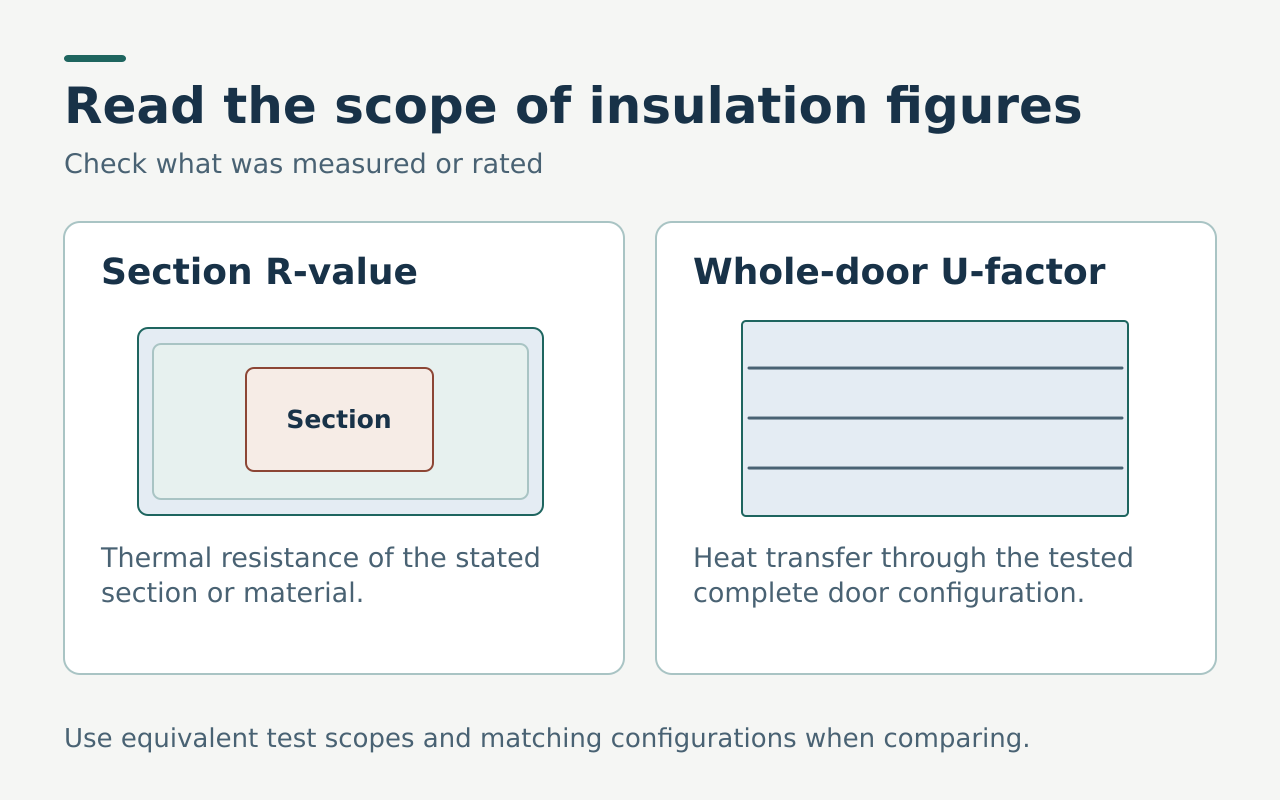
R-value measures how well a material resists heat flow. A higher number means better resistance. For a garage door, a published R-value usually describes the center of a section, not the whole installed door.
U-factor measures how much heat passes through, and for a garage door it describes the complete installed door, including the edges, joints, and any windows. A lower U-factor is better.
DASMA, the garage door industry’s trade association, explains in its technical data sheet TDS-196 that R-value and U-factor are not simply inverses of each other and that you cannot convert one to the other. The reason is that they describe different parts of the door. R-value looks at the middle of a section. U-factor accounts for the whole assembly.
What that means in practice:
- Do not compare an R-value on one brochure with a U-factor on another.
- Ask each dealer for the same measure, and ask what part of the door it describes.
- A higher R-value on paper does not guarantee a warmer garage, since gaps at the edges, around windows, and at the floor can matter as much.
- A tight bottom seal and well-fitted weatherstripping help any door.
Do you need insulation at all? It depends on the garage. An attached garage with a room above or against it benefits most. A detached storage garage may not justify the extra money. In very cold or hot climates, insulation can also reduce temperature swings if you use the space for projects.
Typical cost. HomeGuide lists insulated doors at roughly $600 to $1,400 or more for the door alone, compared with $250 or so for the lowest-priced single-layer steel. Insulated steel doors are widely sold, and the insulated vs non-insulated guide helps you decide whether the extra cost fits your use.
Insulation types vary. Some doors use polystyrene panels, others use polyurethane foam, and construction can be single-layer, double-layer, or triple-layer. Ask what the quote uses and where the insulation sits in the door. Do not rely on a generic “insulated” label.
Windows in a garage door
Windows add light and character. They also add cost and affect privacy, security perception, and insulation.
Common options include a row of rectangular lites near the top, arched or decorative patterns for carriage-style doors, and long horizontal panes on modern designs. Glass can be clear, frosted, or tinted. Some doors use double-pane glass for better performance.
Placement matters. Top-row windows let in light while keeping the lower part private. Windows at eye level give more light but less privacy. If the garage is used for work or play, think about glare on screens and where light falls.
If you live where building codes or local approvals have wind requirements, tell the dealer. The windows and the door must be part of a tested, matching configuration, so a window change can affect that approval. DASMA’s technical data sheets cover wind-related topics, and your building department can say what applies locally.
Ask the dealer how a broken pane would be replaced, whether glass can be replaced individually, and what the lead time is. Check also whether the glass type affects the insulation rating on the quote.
The garage door windows guide goes through layouts, privacy options, and the trade-offs.
Colors and finishes
Color is the easiest change to see and the one people regret most when picked from a small sample. Look at the sample against the actual house, in morning and afternoon light.
Common approaches:
- Match the trim or siding. A door close to the main body color makes the garage recede. It is a safe choice and suits houses where the garage faces the street.
- Match the trim or accents. A lighter or contrasting door can balance the facade, especially when the trim is a bright color.
- Contrast deliberately. A dark door on a light house can be dramatic, but it shows dust and, in strong sun, may absorb more heat.
- Wood-look finishes. Stained or grained finishes on steel, fiberglass, or composite imitate wood.
Finish quality matters as much as color. Ask how the finish is applied (factory-applied versus painted on site), what the warranty says about fading and peeling, and whether touch-up paint is available years later. Dark colors can fade faster in strong sun, so ask the maker for guidance.
If you plan to repaint later, ask whether the finish accepts paint and what preparation the maker recommends. Painting over a factory finish without the right preparation can peel.
If the house sits in an HOA, ask whether there is an approved color list before you order. The garage door colors guide shows how to pair door colors with siding, trim, and roof lines.
Climate, weight, and upkeep
Your climate should shape the material as much as your taste does.
| Climate or condition | What to think about |
|---|---|
| Coastal or salty air | Metals can corrode faster; ask about finishes and frames that resist it |
| Hot, sunny regions | Dark finishes may fade; heat gain through glass matters |
| Cold regions | Insulation and good bottom seals help; check hardware ratings for cold |
| Humid regions | Solid wood can swell; ask about sealing and edge protection |
| High-wind or storm regions | Ask whether a rated door and hardware package is required locally |
| Freeze-thaw cycles | Check how seals and finish handle repeated expansion and contraction |
Weight. Angi puts a typical single door at about 125 to 250 pounds and a double door at up to about 500 pounds. Heavier doors, such as solid wood, glass, or thick insulated models, need a spring system and opener matched to that weight. Never swap a door for a heavier one without telling the installer, since the balance is set for a specific weight.
Upkeep. Every door benefits from a simple routine: wash the surface, check seals, look at the finish, and watch for changes in how the door moves. Keep your own checks to what you can see from the floor. Leave the springs, cables, and lower brackets to a pro, since they hold dangerous tension.
If a door starts to sag, scrape, or open unevenly, stop using it and call for service.
Materials compared side by side
This table pulls the figures above together. Treat the ranges as approximate national numbers as of November 2026, not quotes.
| Material | Door-only price range | Typical lifespan | Main strength | Main weakness |
|---|---|---|---|---|
| Steel | About $250 to $2,500 | 15 to 30 years | Price range and strength | Dents; rust if scratched |
| Wood | About $1,000 to $4,000 | 20 to 30 years | Natural, customizable look | Upkeep; weight |
| Aluminum | About $250 to $1,400 | 15 to 25 years | Light; resists rust | Dents; frame can bend |
| Fiberglass | About $350 to $3,500 | 20 to 25 years | No rust; wood-look textures | Can crack; finish can fade |
| Wood composite | About $300 to $4,000 | 15 to 20 years | Wood look, less upkeep | Quality varies by maker |
| Glass (full-view) | About $700 to $5,000 | Varies | Light and modern style | Privacy; higher cost |
| Insulated panel doors | About $600 to $1,400+ | Varies by material | Better comfort | Costs more than basic |
The price column comes from HomeGuide’s material-only ranges for single doors. The lifespan column comes from Angi. Installation is separate. Use the table to narrow the field, then ask for quotes on two or three finalists.
A rough way to choose: pick steel if budget and low upkeep lead; wood or a good wood-look door if appearance leads and you accept upkeep; aluminum with glass for a modern look; fiberglass or composite if moisture is the main worry.
Brands and how to compare them
Many companies make garage doors, and the same manufacturer often sells several lines at different prices. The name on the door is less useful than the specification behind it.
Compare brands on a short list of facts:
- The exact model and what it is made of.
- Skin thickness and insulation type.
- What the warranty covers, for how long, and for whom (the original owner or later owners).
- Whether the hardware and springs are included in the warranty.
- Who handles warranty service: the maker or the local dealer.
- How easy it is to get matching panels and parts years from now.
Do not rely on a ranking from a sales page. Look at the written specification for the model you are quoted and ask the dealer to put the details in the quote. If two quotes name different makers, ask each dealer why they recommend theirs for your garage.
Product claims and warranty terms change, so read the current manual and warranty documents from the maker, not a summary from a third party. The garage door brands guide and the Clopay vs Amarr comparison walk through how to compare makers by specification.
Common choice problems and what to do next
| What you notice | What it may mean | What to do |
|---|---|---|
| Two quotes list the same material at very different prices | Different thickness, insulation, or hardware | Ask both to list specifications in writing |
| A door looks great in the brochure but wrong on the house | Scale, color, or panel pattern mismatch | Ask for a sample and view it against the house |
| The quote says “insulated” with no detail | Vague insulation claim | Ask for the type, layers, and the measure used (R-value or U-factor) |
| You want a heavier door on an existing opener | The opener may need to match the weight | Share the opener model and ask for a compatibility check |
| A custom door has a long lead time | Factory build time | Ask for dates in writing and plan access in the meantime |
| The HOA has appearance rules | Approval may be required | Take the exact model and color to the HOA before ordering |
| Wind rating matters locally | A matching rated configuration is needed | Ask the building department and the dealer which version applies |
| Existing door is old and parts are scarce | Matching a new design may be hard | Ask about whole-door replacement rather than patching |
If parts for your current door are scarce or several panels are damaged, ask the installer whether repair or whole-door replacement makes more sense.
DIY or pro: what you can do and what is always pro
When to call a pro. Leave removal, installation, and adjustment of a garage door, its springs, cables, tracks, and opener to a trained technician. If a door is unstable, off its tracks, or has a damaged spring or cable, stop using it, keep people and vehicles clear, and call a professional.
Here is how the work divides.
| You can | A pro should |
|---|---|
| Browse styles and collect photos of homes you like | Do the final site measure |
| Compare specifications and warranties from dealers | Remove the old door and hardware |
| Take rough floor-level opening measurements on a sound door | Fit tracks, springs, cables, and panels |
| Check HOA rules and local requirements | Set door balance and travel |
| Ask for written quotes with the same scope | Match the opener to the door weight and test its safety features |
| Look at samples in daylight | Fix anything that fails a check |
Choosing a style and material is the part you control. The fitting is the part to leave alone. A single door can weigh 125 to 250 pounds, and a double door up to about 500 pounds, held up by springs under heavy tension.
What garage doors cost
The table gives approximate national ranges in U.S. dollars, as of November 2026. Prices vary by region, door size, and contractor, so use the ranges as a sanity check and get two or three written quotes. The garage door costs guide covers the full budget.
| Item | Typical range | What pushes it up |
|---|---|---|
| New single door, installed | $600 to $1,900 | Insulation, windows, material, wind rating |
| New double door, installed | $1,000 to $3,000 | Width, weight, glass |
| Steel door, door only | About $250 to $2,500 | Thickness, insulation, finish |
| Wood door, door only | About $1,000 to $4,000 | Species, custom work |
| Glass door, door only | About $700 to $5,000 | Size, glass type |
| Installation labor, door bought separately | About $150 to $500 | Site conditions, removal |
| New opener, installed | $300 to $900 | Drive type, features |
More reference points: This Old House puts a typical new garage door at about $1,151 to $1,869, averaging near $1,400. Lawnstarter’s 2026 figure for an average double-door replacement is about $2,100, in a range of $910 to $3,290. Liberty Home Guard lists about $600 to $1,300 for a 9 by 7 door and $1,000 to $2,300 for a 16 by 7 door.
What moves your price most is the material, the insulation, and the glass. Size is next. Removal and disposal of the old door, trim work, and any opener replacement often show up as separate lines, so compare quotes line by line.
Safety when changing a door
A new door can change the weight and balance of the system, so the installer needs to set the springs and test the opener for that specific door. Do not reuse old springs, cables, or brackets unless the installer confirms they suit the new door.
At handover, ask the installer to demonstrate normal travel, the emergency release, and the opener’s reversal and photo-eye checks, using the opener manual and a working door. Do not try to bypass or disable a safety feature, and do not test anything on a door that is damaged or out of balance.
Keep children, pets, and vehicles away from the work area during installation. Store the manuals, the model details, and the warranty documents together. DASMA’s homeowner safety guidance advises leaving garage door installation and repair to trained technicians, and your door’s own manual is the right reference for tests and checks on your model.
Four real-life choice scenarios
These are composite examples, not case studies. Prices and details vary.
The budget refresh. A homeowner with a detached garage used for storage wants a cleaner look. Insulation is not a priority. They compare a single-layer steel door with a basic insulated steel door and choose the simpler one, then spend the savings on a better finish. The quote lists the gauge, the finish warranty, and the bottom seal.
The cold-garage upgrade. A family uses the attached garage as a workshop. They compare two insulated doors. One brochure lists an R-value and the other a U-factor. They ask both dealers for the same measure and learn that the numbers describe different parts of the door. They choose based on the written specification, the seals, and the warranty rather than the bigger number.
Wood look, low upkeep. A homeowner on a humid coast wants a carriage-house look. Real wood would need regular refinishing, so they compare composite and fiberglass wood-look doors. They ask each dealer about edge sealing and fade warranties, look at samples in afternoon sun, and pick the one with the clearer warranty.
The glass door and the neighbors. A homeowner loves full-view glass for a studio garage but worries about privacy. The dealer shows frosted and tinted samples. After seeing them with the lights on at dusk, the homeowner chooses frosted panels in the top rows and solid panels below.
Where these price ranges come from
The ranges in this guide were compiled in November 2026 from published national cost guides. They are not local quotes. Sources included HomeGuide’s garage door price guide for material-only ranges by type, This Old House’s garage door cost guide, Lawnstarter’s double-door replacement guide, Liberty Home Guard’s replacement cost guide, Fixr’s garage door cost guide for the wood-door range, and TaskRabbit’s replacement cost guide for the labor range. Lifespans and typical door weights come from Angi’s guide to garage door replacement. Insulation figures for steel, aluminum, and wood doors come from This Old House.
The explanation of R-value and U-factor comes from DASMA technical data sheet TDS-196. Where sources disagreed, the ranges were widened to cover most of them. Confirm all figures with written local quotes.
FAQ
What is the most popular garage door material?
Steel is the most common choice for homes in North America because it combines a wide price range with strength and many styles. Insulated steel sectional doors are the usual default. Whether it is right for you depends on your climate, budget, and how you use the garage.
Is an insulated garage door worth the money?
It can be, especially for an attached garage or a workshop. Published guides put insulated doors at about $600 to $1,400 or more for the door alone. For a detached storage garage the extra cost may not pay back, so decide based on how you use the space.
What is the difference between R-value and U-factor?
R-value measures resistance to heat flow, usually at the center of a door section. U-factor measures heat passing through the whole installed door, including edges and windows. DASMA says they are not simple inverses, so ask dealers for the same measure when comparing.
Which material lasts longest?
Angi’s ranges put steel and solid wood at up to about 30 years, with fiberglass at 20 to 25, aluminum at 15 to 25, and wood composite at 15 to 20. Actual life depends on weather, use, upkeep, and how well the system is maintained.
Are wood garage doors hard to maintain?
Real wood needs regular sealing and refinishing, and how often depends on sun and moisture exposure. If you like the look but not the upkeep, ask about composite, fiberglass, or steel doors with a wood-grain finish, and compare their warranties.
Can I put a heavier door on my current opener?
Maybe, but not without checking. Heavier doors need a spring system and opener matched to their weight. Give the installer your opener model and the door you want, and ask them to confirm compatibility in writing before the order is placed.
Should I choose windows in my garage door?
Windows bring light and style but add cost and affect privacy and insulation. Top-row windows are a common compromise. Ask about glass type, replacement of a single pane, and whether windows change any wind rating or insulation figure on the quote.
Next step
- Write down how you use the garage, your climate, and any HOA rules, then pick two or three finalists from the comparison table.
- Request written quotes that name the model, material, insulation type, windows, and warranty, and ask your installer to confirm the opener fits.
- Use this guide on garage door styles and materials to compare quotes line by line before you pay a deposit.