Garage Door Cables Explained: Lift Cables and Safety Cables
Garage door cables come in two kinds with different jobs. Lift cables carry the force from the springs to the bottom of the door so it rises and lowers evenly. Safety cables, on extension-spring systems, pass through the spring to help contain it if it breaks. Fraying, slack, or a cable that has left its path means stop using the door. As of November 2026, cable repair typically costs about $150 to $350, according to HomeGuide.
This page is part of the larger garage door springs and cables guide, which covers the whole counterbalance system.
When to call a pro. Cables are under tension and are tied to springs, drums, pulleys, and bottom brackets. Do not touch, re-seat, or replace a cable yourself. If a cable is frayed, slack, or off its path, or the door is crooked or partly open, keep people clear and call a technician.
Contents
- Two cables, two jobs
- How a lift cable problem looks
- What a technician checks
- Drums, pulleys, and bottom fixtures
- Reading a cable replacement quote
- What cable work costs
- Visual care and stop-use signs
- Quick checklist
- In this guide cluster
- DIY or pro
- Where these price ranges come from
- FAQ
- Next step
Two cables, two jobs
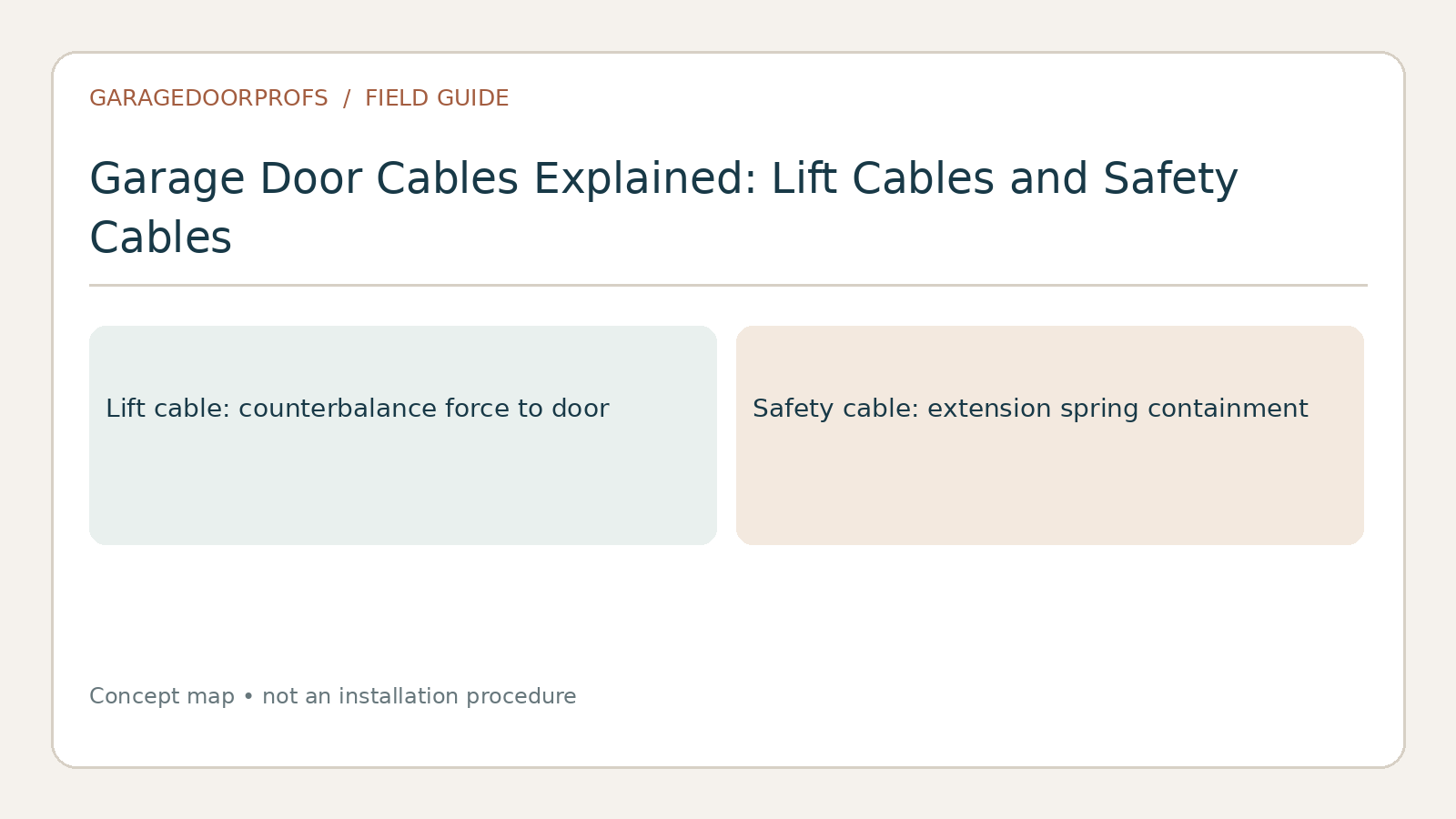
The word “cable” covers two different parts, and the difference matters when you read a quote.
| Cable | Where it is | What it does |
|---|---|---|
| Lift cable | Runs from a fixture at the bottom of the door up to a drum or pulley | Transfers the spring’s force so the door rises and lowers evenly |
| Safety cable | Passes through an extension spring on systems that use them | Helps contain the spring or parts if the spring fails |
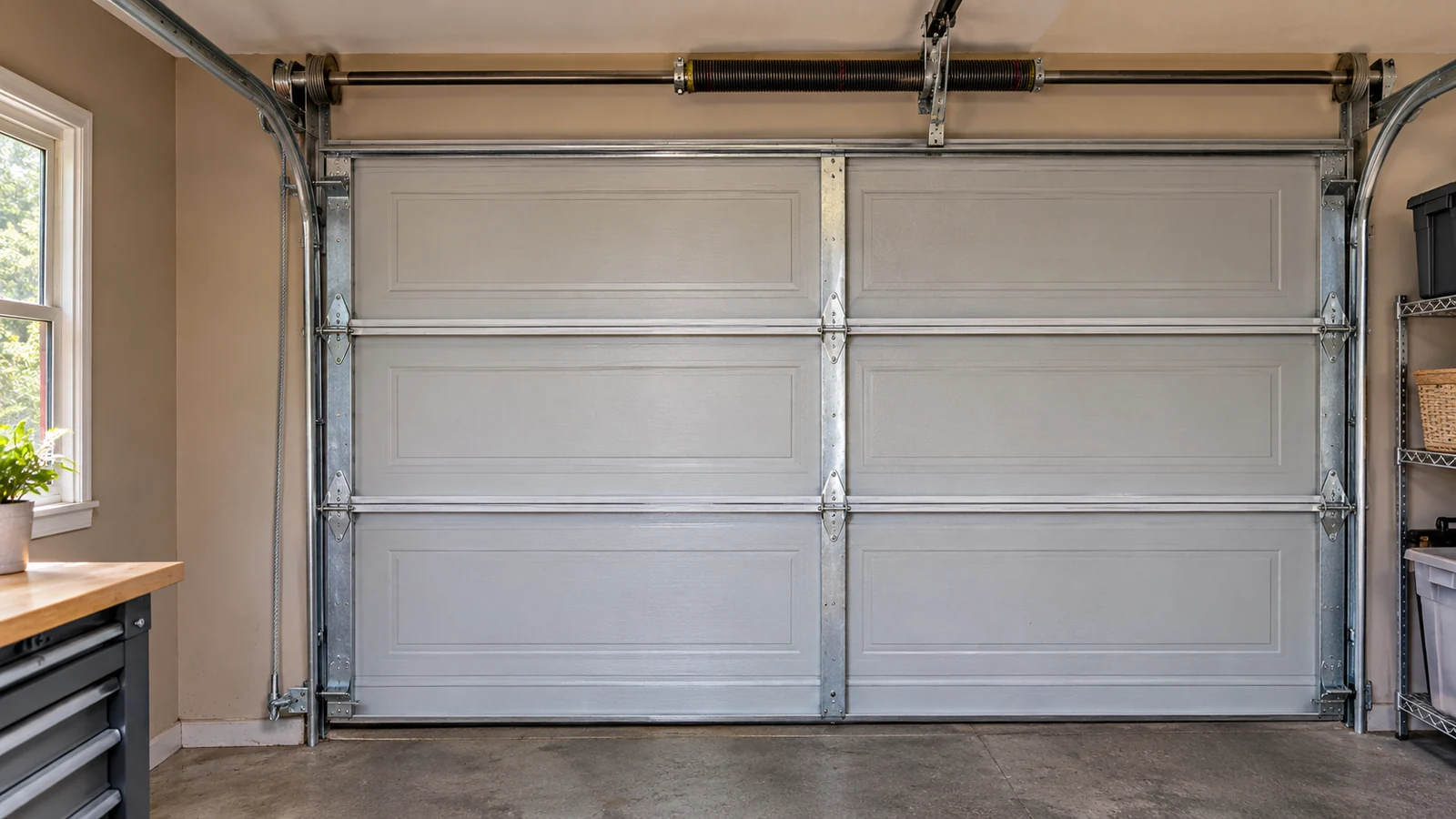
On a common torsion-spring door, a lift cable runs from the lower door fixture to a cable drum on the shaft above the door. The springs act on the shaft, and the drums manage the cables as the door moves. On extension-spring systems, lift cables usually route through pulleys, and the arrangement differs.
A safety cable does not lift the door in routine travel. It is a containment measure. Not every door has one, because it applies to an extension-spring arrangement. If a quote says “safety cable,” ask the technician to say which part they mean and where it goes. Neither type is a safe place for an owner to adjust. DASMA’s homeowner safety tips give general precautions for door systems.
How a lift cable problem looks
From a safe place on the floor, a cable problem can show up as:
- A cable that looks frayed, with broken strands or corrosion
- A cable that hangs slack or has lost its path
- One cable that looks visibly different from its mate
- A door that rises crookedly, sticks, or stops
Those symptoms can also come from other hardware, so do not guess which part has failed from a sound or a glance. Stop using the opener, and keep clear of the opening, especially if the door is part open or tilted.
Do not pull the emergency release, lift one side, or wind a loose cable back onto a drum. A damaged counterbalance can shift without warning. A photo from the floor, plus a note about which side changed, helps the company. Tell them if a vehicle or person is blocked inside.
What a technician checks
A good inspection looks at the whole system, not only the cable that failed. It should cover:
- Both cable paths and their attachment points
- Springs, drums or pulleys, the shaft, and bearings
- The bottom fixtures and brackets
- Tracks, rollers, and the door’s balance and level
- The cause of the failure, so it does not recur
Matching the cable length, construction, and routing matters. A cable replaced without understanding why it left its path may fail again. Ask for the cause and the specification of the replacement parts. On an extension-spring system, ask whether safety cables are present and properly installed. On a torsion system, do not confuse a lift cable with a spring containment cable. The cable replacement guide explains what a professional checks, and the safety cable guide covers their purpose and inspection.
Drums, pulleys, and bottom fixtures
Drums organize the cable’s travel on many torsion systems. Pulleys redirect the cable on many extension systems. Worn bearings, mismatched parts, shifted supports, or a damaged lower fixture can all affect how a cable behaves. The bottom bracket is a sensitive point because it takes cable force on many doors, which is why the bottom bracket guide explains why it is not a do-it-yourself repair.
For details on specific parts, see the guides to cable drums, pulleys, and cable length and thickness, plus the overview of the counterbalance system. Ask the quote to identify every affected part and to separate required replacement from preventive suggestions. If both cables are proposed, ask why, and whether they come as a matched set. The technician must restore proper travel and balance before the opener is used normally.
Reading a cable replacement quote
Ask for a written diagnosis that lists:
- The cable type, number of cables, and specification
- Related parts, such as drums, brackets, or rollers
- Labor, service fee, and any after-hours charge
- The warranty on parts and on labor
- How the technician will check that the door moves evenly and the opener’s protections work
A cable-only part price is not the cost of restoring a door that came off its track or has a broken spring. If another component failed first, the quote should list its repair as a separate item. Do not approve a quick “re-wrap” without an explanation of why the cable came off.
Keep the invoice and part details for the next visit. The guide to choosing a repair company covers what to ask before work starts.
What cable work costs
As of November 2026, published cost guides put cable repair at about $150 to $350. HomeGuide lists a standard replacement of both cables at about $150 to $250, and emergency repairs at about $250 to $350 or more. Angi puts cable repair at about $100 to $350. This Old House says labor for cable repairs adds about $86 to $192, and lists a combined spring and cable job at about $200 to $500.
The total goes up when the failure damaged a drum or bracket, when a spring also needs replacing, when the door is heavy or tall, or when the call is after hours. The typical service call is $50 to $150, with evening and weekend calls adding about 25 to 50 percent. The cable replacement cost guide goes deeper, and the spring warranty guide is useful if springs are part of the job.
Visual care and stop-use signs
On a sound door, follow the maker’s maintenance guide for safe visual checks from the floor. Do not handle a cable to feel for broken strands, do not lubricate one unless the manual explicitly says to, and do not climb near a drum.
Look from a safe position, and report any of these:
- Fraying, rust, or corrosion
- Slack in one or both cables
- Rubbing against another part
- Unequal door travel
If a spring breaks or a cable snaps, keep people away, stop operation, and contact service. An opener is not a substitute for the counterbalance. The guide on what to do when a cable snaps and the one on frayed cables explain the next steps. Save the invoice, a note of prior work, and a photo of accessible labels to help the next technician.
Quick checklist
- You know the difference between a lift cable and an extension-spring safety cable.
- You stopped using the door if a cable looked frayed, slack, or off its path.
- You did not touch cables, drums, pulleys, springs, or bottom brackets.
- You told the company about any trapped vehicle or person.
- The quote names the cable type, number, related parts, labor, and warranty.
- You asked why the cable failed and how it will be prevented.
- You kept the invoice and part details.
In this guide cluster
- Garage door cable replacement: what a professional checks.
- Bottom garage door brackets: why they are not a DIY repair.
- Frayed garage door cables: why the door should be inspected.
- Garage door cable drums: types and compatibility.
- Extension spring safety cables: purpose and inspection.
- Garage door pulleys: wear, bearings, and replacement decisions.
- Cable length and thickness: why exact matching matters.
- Counterbalance systems: springs, shafts, and drums working together.
- Spring warranties: cycles versus years.
- Garage door cable replacement cost: what the job costs and why quotes differ.
- Cable snapped: what to do right away.
DIY or pro
You can observe from the floor, photograph from a safe distance, and gather your door and opener model labels. You can also read the quote and ask questions. Replacing a cable means working next to springs, drums, and bottom brackets that hold significant force, so it is a technician’s job. The money saved by doing it yourself is small next to the risk of injury.
Safety box. Do not handle a cable, loosen a bracket, or try to rewind a drum. Do not use the opener or the emergency release on a door with a snapped cable, since it can become unbalanced, tilted, or unstable. Keep children and pets out of the garage until the door is fixed.
Where these price ranges come from
The ranges were compiled in November 2026 from published national cost guides and are not local quotes. They include HomeGuide’s cable repair cost guide, Angi’s cable repair cost guide, and This Old House’s repair cost guide. Service-call and after-hours figures come from national repair cost guides. Safety references come from DASMA’s homeowner safety tips. Get local written quotes before you decide.
FAQ
What is the difference between a lift cable and a safety cable?
A lift cable is part of the door’s counterbalance path in routine movement. A safety cable on an extension-spring system is a containment measure if a spring or related part fails. Routing and specification vary by system, so have a technician identify the actual parts.
Can I replace a frayed garage door cable?
Do not handle or replace it yourself. Cables interact with springs, drums, pulleys, and bottom fixtures that can hold significant force. Stop using the door and arrange a professional inspection. Ask why the cable frayed and which matched parts will be installed in its place.
Can the opener move a door after a cable snaps?
Do not try. The door can become unbalanced, tilted, or unstable, and the opener is not built to repair a counterbalance fault. Keep people and vehicles out of its path, avoid the release on a damaged door, and call for service.
Do all doors have extension-spring safety cables?
No. The term describes a containment part on an extension-spring arrangement. Other systems use different parts, and lift cables have a separate job. Identify your installed system from the manufacturer’s documents and a professional inspection before you try to interpret a quote.
Next step
- If a cable is frayed, slack, or off its path, stop using the door and keep clear.
- Call a technician and describe what you see, including any trapped vehicle.
- Ask for a written scope that lists the cables, related parts, labor, and warranty, and keep the invoice.