Steel Garage Doors: Construction, Finishes, and Tradeoffs
Steel garage doors are the most common choice because they balance cost, strength, and style. They range from a single layer of thin steel to triple-layer insulated models, and the differences matter more than the word “steel.” As of November 2026, HomeGuide puts a steel single door at roughly $250 to $2,500 for the door alone, and Angi puts steel door life at about 15 to 30 years. Compare the specific model: its construction, finish, insulation, and warranty.
This page is part of the larger garage door styles and materials guide, which compares every material.
When to call a pro. Installing or replacing a steel door means handling a heavy door, springs, and cables. Leave removal, installation, and balancing to a trained technician. Stop using a door that is dented badly enough to bind, crooked, or off its track.
Contents
- How steel panels are built
- Gauge, layers, and strength
- Finishes, rust, and dents
- Insulation and thermal claims
- Style, windows, and matching later
- Steel compared with other materials
- Cost and lifespan
- Questions to ask a dealer
- Quick checklist
- In this guide cluster
- DIY or pro
- Where these figures come from
- FAQ
- Next step
How steel panels are built
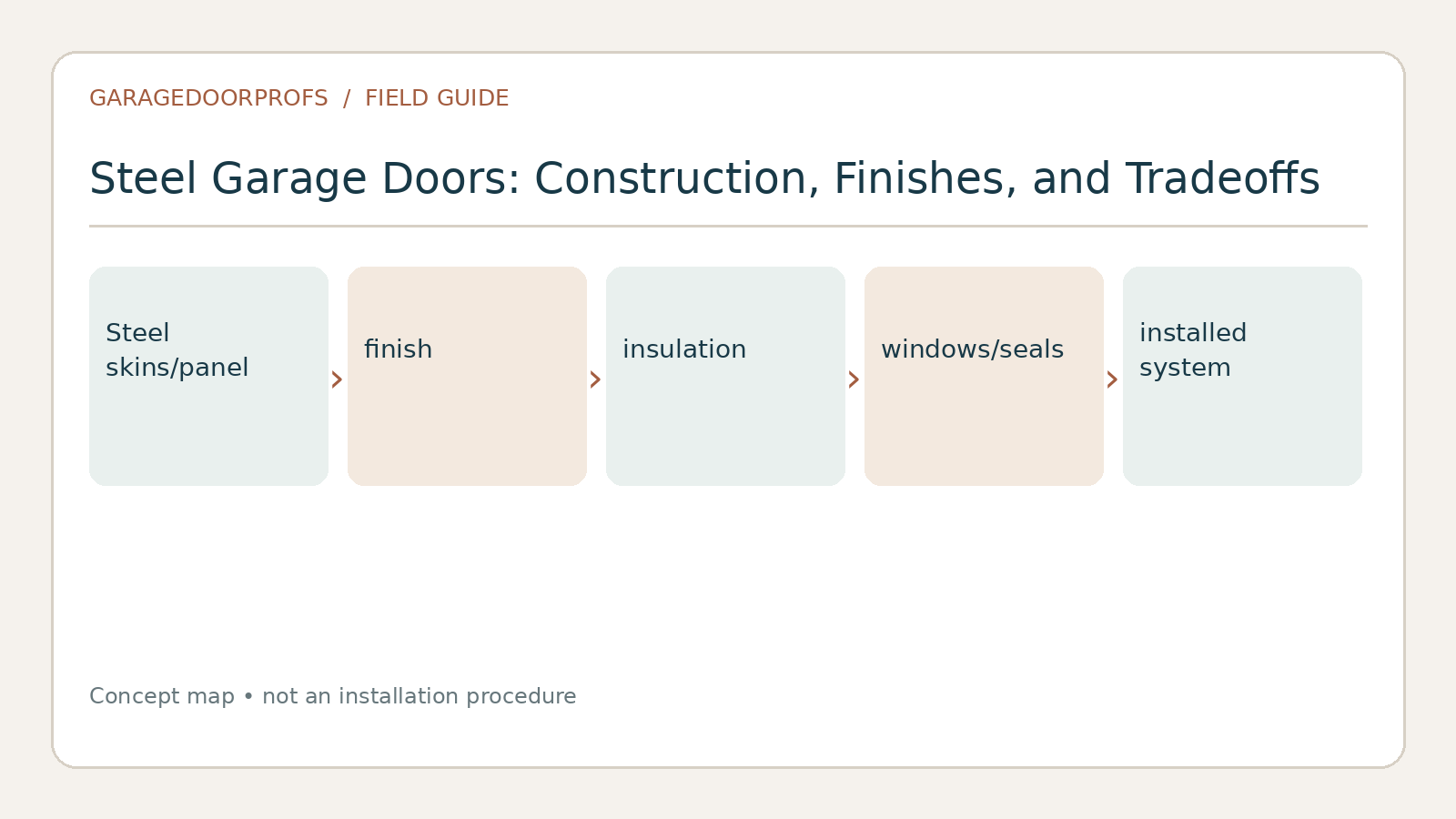
A sectional steel door is made of horizontal panels. The way each panel is built sets how stiff it feels, how well it insulates, and how it ages.
| Construction | What it is | Usually means |
|---|---|---|
| Single layer | One skin of formed steel, often with no insulation | Lowest price; can flex and sound hollow |
| Steel with an insulation layer on the back | An exterior skin with insulation attached to the inside | Better thermal performance than bare steel |
| Sandwich (steel-insulation-steel) | Insulation between a steel exterior and a steel or other interior skin | Stiffer panel and more insulation; higher price |
Makers use their own names for these designs, so ask for a cross-section or a technical sheet for the exact model. A decorative surface does not show the core, the reinforcement, or how a window opening is built.
Panel construction also affects weight. A heavier door needs a spring system and opener matched to that weight. Heavier is not automatically better for a given opening, so the installer should confirm the complete door, counterbalance, and opener work as a system. Angi puts a typical single door at about 125 to 250 pounds and a double door at up to about 500.
Gauge, layers, and strength
Steel thickness is described by gauge, and gauge numbers run backward: a lower number means thicker steel. Two doors that both say “steel” can use different thicknesses, so ask what gauge the maker uses and where. Thicker steel generally resists denting better, but layers, reinforcement, and design also matter. A well-built sandwich panel of thinner steel can feel stiffer than a thin single-layer panel.
Angi’s lifespan breakdown reflects that. Steel overall is listed at about 15 to 30 years. Guides that split steel by construction put single-layer doors toward the shorter end, at around 15 to 20 years, and triple-layer doors toward the longer end, at around 25 to 30. Your door’s actual life depends on use, weather, upkeep, and repairs. A door opened several times a day wears faster than one opened once.
Ask for the construction and thickness in writing. “Heavy duty” on a brochure is not a specification.
Finishes, rust, and dents
Steel doors use factory coatings, paints, textures, and overlays. Wood-look finishes on steel imitate real wood without having the same construction or care needs.
Know the difference between three problems:
- A dent. Common after a bump from a car, a ball, or a bicycle. A shallow dent may only be cosmetic, but a sharp or deep one can weaken a panel or interfere with the hinges.
- Surface scratches. If a scratch goes through the coating to bare steel, rust can begin, especially in damp air or near salt, as on a coast or on roads treated with salt.
- A puncture or crease. Usually needs a panel replaced.
Ask what the warranty covers for finish defects, fading, and corrosion, and what it excludes. Many warranties exclude impact damage. A blanket “rustproof” claim is not a warranty term. If you live near the coast or on salted roads, ask the maker for the product’s stated limits for that environment.
Read the maker’s cleaning and touch-up guidance before choosing a color. Harsh cleaners or the wrong touch-up product can harm the coating. Dark colors can fade faster in strong sun, so ask about fade resistance. The steel door cleaning guide covers general care.
Insulation and thermal claims
Insulation can make sense when the garage is attached to the house, has a room above it, or is used as a workshop. It matters less for a detached storage building.
Two measures cause confusion:
- R-value describes resistance to heat flow, and for garage doors it usually describes the center of a section.
- U-factor describes heat flow through the complete installed door, including edges, joints, and windows. Lower is better.
DASMA’s technical data sheet TDS-196 explains that they are not simple opposites and that one cannot be converted into the other. Ask the seller which one they are quoting, for what part of the door, and by what test. This Old House says insulated steel and aluminum doors can reach R-values up to about R-17, but real performance also depends on seals, the fit of the installation, windows, the garage walls, and ventilation. A door with insulation does not turn an unconditioned garage into a heated room. The insulated vs non-insulated guide helps you decide if the extra cost is worth it.
Style, windows, and matching later
Steel doors are sold in flush, raised-panel, carriage-style, and modern designs, depending on the maker. Ask for a physical sample, or a documented color reference, and look at it in the light where the door will be seen.
Windows add light and change privacy. They can also change the door’s weight and its insulation performance, and in areas with wind requirements they can affect the approved configuration. Compare glass and placement within the exact model.
If you might need a matching panel years from now, keep the model, finish, and installation records. Makers change collections and finishes over time, so a similar-looking panel is not proof of compatibility. Ask whether single sections can be ordered later and on what terms. Do not assume a panel from another door of the same width will fit.
Steel compared with other materials
| Question | Steel | Compare with |
|---|---|---|
| Price range | Wide, from budget to premium | Wood and glass usually cost more |
| Dents | Can dent; thicker steel resists better | Fiberglass can crack instead |
| Rust | Possible if coating is scratched | Aluminum and fiberglass do not rust |
| Upkeep | Washing and finish checks | Real wood needs periodic refinishing |
| Weight | Moderate; varies with insulation | Wood and glass can be heavier |
If a sales claim says “maintenance free” or “the strongest,” ask for the specification and warranty limit in writing. Choose from actual product data rather than a stereotype about the material. The comparisons for steel vs wood, steel vs aluminum, and fiberglass vs vinyl go deeper, along with guides to wood, aluminum, fiberglass, vinyl, and composite doors, and a look at wood-look vs real wood.
Cost and lifespan
As of November 2026, approximate national figures are:
| Item | Typical range |
|---|---|
| Steel single door, door only | About $250 to $2,500 (HomeGuide) |
| New single door, installed | About $600 to $1,900 |
| New double door, installed | About $1,000 to $3,000 |
| Insulated door, door only | About $600 to $1,400 or more |
| Lifespan, steel | About 15 to 30 years (Angi) |
The cheaper end of the steel range tends to be single-layer doors. The upper end tends to be insulated, thicker, or customized. Installation, removal of the old door, windows, and opener work are separate lines on many quotes. See the steel door cost guide for what moves the price, and the costs guide for the full budget. Get local written quotes, since regional prices vary.
Questions to ask a dealer
- What is the exact model, and can I see a cross-section?
- What steel gauge is used, and is the door insulated?
- Is the insulation rating an R-value or a U-factor, and for what part of the door?
- What does the finish warranty cover, and what does it exclude?
- What does the quote include: removal, hardware, opener checks, labor, and disposal?
- Can a single panel be ordered later if one is damaged?
- Who handles warranty service, the maker or the installer?
Request a written quote with the exact model, color, panel design, insulation, windows, hardware, seals, removal, and labor. After installation, save the care guide and the warranty, and ask the installer to demonstrate normal travel and the opener’s safety checks.
Quick checklist
- You compared specific models, not just the word “steel.”
- You know the panel construction, gauge, and insulation type.
- You asked which insulation measure is quoted and for which part of the door.
- You read the finish, rust, and dent terms in the warranty.
- You saw a physical sample in your own light.
- You know whether single panels can be ordered later.
- Your quote lists removal, hardware, labor, and the opener check.
In this guide cluster
- Wood garage doors: species, construction, and care needs.
- Aluminum garage doors: weight, finish, and corrosion questions.
- Fiberglass garage doors: where the material fits.
- Vinyl garage doors: durability and design limits.
- Composite garage doors: core, skin, and maintenance.
- Steel vs wood garage doors: how the two compare.
- Steel vs aluminum garage doors: weight, finish, and price.
- Fiberglass vs vinyl garage doors: which suits which setting.
- Wood-look vs real wood doors: the trade-off in looks and upkeep.
- Steel garage door cost: what moves the price.
- Cleaning a steel garage door: care that protects the finish.
DIY or pro
You can compare models, look at samples, ask the questions above, and care for the finish as the maker directs. Installing a steel door means handling a heavy door with springs and cables under tension, so it belongs to a trained installer. Cost guides put professional labor at about $150 to $500 when the door is bought separately.
Safety box. Do not try to lift, straighten, or remove a damaged or dented door that binds in the track. Keep people clear of its path, and do not adjust springs, cables, or brackets. Call a technician.
Where these figures come from
Prices were compiled in November 2026 from published national cost guides, including HomeGuide’s material-only single-door ranges and a This Old House cost guide, and are not local quotes. Lifespans and door weights come from Angi. Insulation figures come from This Old House, and the R-value and U-factor explanation comes from DASMA technical data sheet TDS-196. Get local written quotes before you decide.
FAQ
Are all steel garage doors insulated?
No. Steel doors are sold with different constructions, and insulation varies by model. Ask for a cross-section and the maker’s published configuration and thermal information. If comfort matters, compare the whole installed assembly, including the windows and seals, not only the panel.
Will a steel door rust?
It depends on the finish and care. A scratch that goes through the coating can let rust start, especially near salt or in damp air. Read the maker’s coating, cleaning, and touch-up guidance and the warranty terms, and avoid blanket guarantees.
Can a dented steel panel be replaced?
Sometimes, if a compatible section with the right model, profile, size, and finish is available and the rest of the door is sound. A technician should inspect the damage and the hardware. Ask for a panel quote alongside a full replacement quote.
Does a higher R-value guarantee a warm garage?
No. Check what the number measures and the test used, then consider windows, seals, installation gaps, garage walls, and ventilation. A panel’s rating is not the same as the comfort of the whole garage. Ask for documentation for the exact door configuration.
Next step
- Pick two or three specific steel models and ask for cross-sections, gauge, and insulation details.
- Ask each dealer for a written quote that lists the finish warranty, removal, hardware, and the opener check.
- Use this guide to compare quotes line by line before you pay a deposit.