Garage Door Costs Explained: Repair, Replacement, and Installation
Most garage door repairs cost roughly $150 to $400 in the United States as of November 2026. Spring replacement usually runs $120 to $350, a new opener installed is about $300 to $900, and a new double door typically lands between $1,000 and $3,000 installed. Evening and weekend calls can add $50 to $150 or 25% to 50% on top. Your own price depends on which part failed, what the door weighs, your area, and what the quote includes. That last point matters most, so this guide shows how to read a quote line by line.
What you’ll learn
- Typical price ranges for the ten jobs homeowners ask about most, with the date they apply to.
- What service-call fees, after-hours charges, and “extras” really cover.
- How to compare two or three quotes so the numbers mean the same thing.
- When repair beats replacement, shown with four worked examples.
- Which jobs you should never price as a DIY project.
Contents
- Garage door costs at a glance
- How to read garage door costs
- Parts, labor, and the scope of a repair
- Emergency and after-hours service
- Service-call and diagnostic fees
- Hourly and flat-rate labor
- Compare quotes using the same scope
- Build a budget before you call
- What affects the cost of a replacement door?
- Spring replacement cost factors
- Opener installation and replacement costs
- Tune-up and planned maintenance charges
- Insurance and repairs after damage
- Problems and the cost bucket they usually fall into
- Four real-life cost scenarios
- Where DIY is appropriate and where to hire a pro
- Where these price ranges come from
- FAQ
- Next step
Garage door costs at a glance
The table below gives approximate national ranges, in U.S. dollars, as of November 2026. They combine labor and parts unless noted. Treat them as a way to spot a quote that is far outside normal, not as a price you should expect. A single published guide can sit above or below the others by $100 or more, so the ranges here stay wide on purpose.
| Job | Typical range (installed) | What pushes it up | DIY or pro |
|---|---|---|---|
| Service call or diagnostic visit | $50 to $150 | Distance, time of day, whether it is credited to the repair | Pro |
| General repair (one common part) | $150 to $400 | Hard-to-find parts, older doors, two failures at once | Pro for anything under tension |
| Spring replacement | $120 to $350 | Torsion vs. extension, door weight, cycle rating, a pair vs. one | Pro only |
| Cable replacement | $100 to $400 | Whether springs or drums also need work | Pro only |
| Roller replacement (set) | $100 to $250 | Nylon vs. steel, door height | Pro recommended |
| Track repair or replacement | $125 to $400 | Bent vs. broken, one side vs. both | Pro recommended |
| Single panel (section) replacement | $250 to $1,000 | Whether a matching section is still made, insulation | Pro |
| Opener, installed | $300 to $900 | Chain vs. belt vs. wall-mount, power, smart features | Pro or experienced DIYer for the opener only |
| New single door, installed | $600 to $1,900 | Size, insulation, windows, wind rating | Pro |
| New double door, installed | $1,000 to $3,000 | Same as above, plus a wider span | Pro |
| Tune-up with lubrication | $45 to $100 | Add-on repairs found during the visit | Owner tasks plus pro visit |
A few figures behind that table, for context. A national average for garage door repair sits near $264, with most jobs between $155 and $378 in HomeAdvisor’s data. Fixr puts most repairs between $150 and $600, with common fixes between $160 and $350. Replacing a door costs more: HomeAdvisor lists an average replacement cost of $1,223, and a 2026 This Old House guide reports $1,151 to $1,869, about $1,400 on average for a standard installation.
How to read garage door costs
Start by naming the outcome the quote is meant to deliver. A company might charge to inspect and diagnose, to make an unstable door safe on the first visit, to restore one part, or to supply and install a complete new system. You cannot compare prices until you know which outcome each company is offering.
Write the expected end state next to every estimate, for example “door closed and secure until parts arrive” or “door working and tested with the existing opener.”
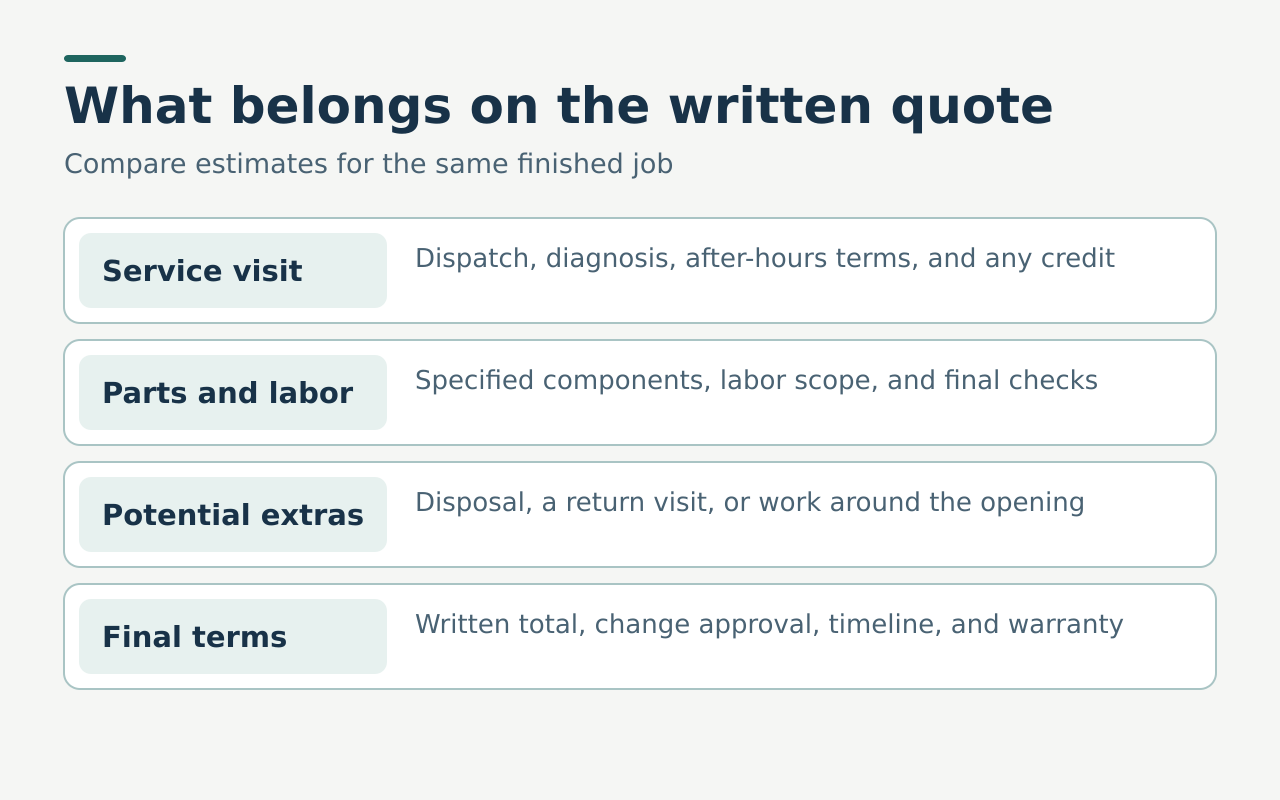
Then break the number into its pieces:
- Service call. Pays for travel and some diagnostic time, on terms the company sets.
- Parts. The items listed on the quote, ideally with a description or part number.
- Labor. The specific work, either at a stated rate or as a flat amount.
- Extras. Special ordering, removal and disposal, repairs to the surface a part mounts to, a second visit, electrical work, or an after-hours charge.
An estimate and an invoice are different documents. The estimate shows what the company proposes and what it assumed. The invoice shows what you were billed. Before work starts, agree in writing how changes get approved. If a hinge has torn out of a section and the technician finds more damage than expected, the company should call you, explain, and give a revised price before doing work outside the estimate.
Give every company the same facts. Door size, material, age, any earlier repair, and where the door stopped all change what a part costs and whether it is in stock. Send the same photos to each, taken from a safe distance. A quote built on a closed door can change if the technician arrives and finds it hanging open and needing to be secured first.
The FTC’s page on avoiding home improvement scams explains what a written estimate should include and how to check a contractor before you pay.
Parts, labor, and the scope of a repair
“Replace hardware” tells you nothing. A useful repair estimate names the failed part (roller, hinge, track, section, cable, spring), the condition the technician saw, which neighboring parts were checked, and how the door will be tested afterward.
Part prices are small compared with labor on most jobs. In HomeAdvisor’s breakdown, a roller costs $20 to $40 as a part, but $90 to $190 with labor included, and a cable runs about $15 to $50 for the part and $90 to $350 installed. That gap is why the same part can look cheap online and expensive on a quote. You are paying for the trained work, the truck, the insurance, and the testing.
Common repair ranges, as of November 2026, from published national guides:
| Repair | Typical installed range | Note |
|---|---|---|
| Rollers (set) | $100 to $250 | Lawnstarter cites about $100 to $220 for a roller job |
| Cable | $100 to $400 | Fixr lists an average near $225 |
| Track | $125 to $400 | A loose bracket can cost far less than a new track |
| Single section | $250 to $1,000 | Angi cites $350 to $900, averaging about $550 |
| Safety sensor | $100 to $250 | Often a quick alignment or a replacement eye |
The scope can change when damage reaches the point where a part attaches. A bent hinge with sound metal behind it is a different job from a hinge that tore through the section. A track that has shifted may need its mounting surface checked. Both can be described with the same part name on the phone, which is why a quote should state its assumption: “assuming the section is sound at the hinge.”
Ask whether the estimate includes a return visit if a part has to be ordered. On older or discontinued doors, ask what happens if the supplier cannot match the part. The answer sometimes decides whether repair or replacement is the better buy (see the scenarios below).
For a deeper breakdown by repair type, see the garage door repair cost guide.
Emergency and after-hours service
Urgent service is often about securing an unstable door, not finishing the permanent repair. Tell the dispatcher if the door is open, hanging crooked, off track, or blocking a vehicle. If anyone is trapped or in immediate danger, call 911. Keep people and pets clear of the door and leave it where it is until trained help arrives.
Published figures vary a lot for after-hours work:
- Modernize says expect a 25% to 50% increase on the usual service fee for weekend or late-night work.
- Fixr puts after-hours, weekend, or holiday repairs at roughly $250 to $700 or more in total, with weekend service adding $75 to $150.
- One home-services guide calls $50 to $150 a normal after-hours surcharge, and a surcharge of several hundred dollars excessive.
So a fair planning range, as of November 2026, is about $50 to $150 added to the normal price, and you should ask questions if a company quotes several hundred dollars on top of standard pricing for a simple repair.
Before you confirm the trip, ask four things:
- Is the emergency charge one fee, or are there separate after-hours, weekend, and dispatch charges?
- Can the technician make the door safe tonight and finish the permanent repair on a regular-hours visit?
- If a second visit is needed, does the trip charge apply again?
- Can you get the amount and the visit scope in a text or email before the truck leaves?
A reasonable plan separates what must happen now from what can wait. You can approve a “make it safe” visit and leave a full replacement decision for a written assessment later. The emergency garage door repair cost guide lists more questions to ask before authorizing a call.
Service-call and diagnostic fees
A service-call fee is what a company charges to come to your property. It may cover travel, the first stretch of the technician’s time, a basic inspection, or all three. Published figures cluster around $50 to $150:
- This Old House lists a diagnostic visit at $50 to $75, which contractors often knock off the final bill when you approve the work.
- Thumbtack reports a national average of $80 for a service call that includes the first hour of labor and testing.
- Contractor-side pricing from Housecall Pro lists a basic service call at $75 to $150.
The dollar amount matters less than the terms. Ask these before booking:
- What does the fee include (travel, inspection, first hour of labor)?
- Is it credited toward the repair if you approve the work?
- Do you get written findings if you decline the repair?
- What is the charge if you reschedule or if nobody can get access?
Some companies call the inspection “free” and recover the cost in the repair price. Others charge for diagnosis and hand you a written scope you can take to another company.
If you get a phone quote, ask for a short written note describing what the visit covers. The garage door service fee guide shows how to compare travel, diagnosis, credits, and return-visit terms.
Hourly and flat-rate labor
Garage door work is usually quoted as a flat price for a defined job. Some companies, especially for diagnosis or odd jobs, quote an hourly rate with a minimum. Each has risks.
Flat rate. You pay a fixed price for a stated scope. Ask what happens if the technician finds damage outside it. A good flat quote lists what is included (part, labor, testing, handover) and what triggers a written change.
Hourly. You pay for billable time. Ask where the clock starts (arrival or first work), whether travel and parts pickup are billed, what the minimum charge is, and whether the rate applies per technician. Ask for an expected time range and agree that the company calls you before going past it.
Whichever model you choose, write the covered outcome and the conditions for added charges beside each quote. The hourly versus flat-rate labor guide has more questions for each arrangement.
Compare quotes using the same scope
If the door can be left in a safe state, get two or three written estimates. Send each company the same description, photos, and model details. Ask for findings, proposed work, part identifiers, removal and disposal, testing, lead time, warranty terms, and the amount due. For any license your state or city requires, confirm it with the issuing agency and ask for proof of insurance.
Here is a simple comparison grid. Fill it in for each company:
| Question | Company A | Company B | Company C |
|---|---|---|---|
| Total price in writing | |||
| Service fee and whether it is credited | |||
| Parts listed (description or number) | |||
| Removal and disposal included? | |||
| Testing and handover included? | |||
| Lead time and number of visits | |||
| Parts warranty and labor warranty | |||
| What triggers a price change |
Look closely when two quotes differ by hundreds of dollars. The usual reasons are different scope (one replaces both springs, one replaces a single spring), different parts (standard vs. higher-cycle springs, steel vs. nylon rollers), or a missing line (no disposal, no testing, no second visit). Ask each company what it saw that the other did not, and ask whether the door is safe to use while you decide.
Disagreeing diagnoses are a real signal. If one technician says the section is repairable and another says the door needs replacing, ask both what condition they saw and what they still need to inspect. The quote comparison guide covers what to do with unclear line items.
Build a budget before you call
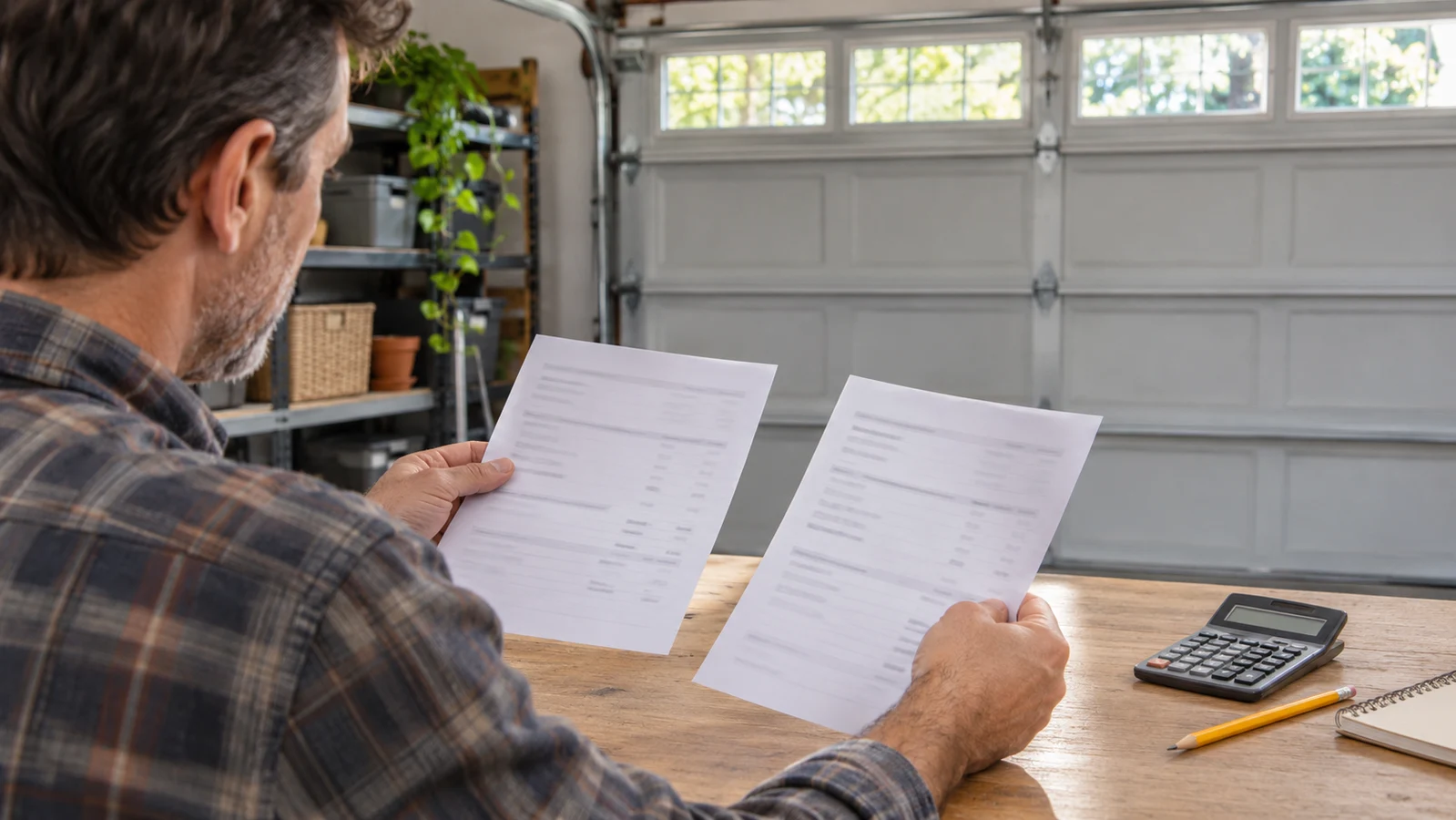
A calculator or a spreadsheet is useful only when the inputs are honest. Start with the work you expect, then add three kinds of lines.
Firm lines come from a written quote: the part, the labor, the service fee. Allowance lines are placeholders for something that depends on a later finding, such as a second section or a mounting repair. Mark them “pending” and put a range beside them, using the table at the top of this guide. Outside lines are costs that sit outside the door company’s work: an electrician for a new outlet, a carpenter for damaged framing, a permit.
Here is an example of how a budget grows. These are illustrations using the ranges above, not quotes.
| Stage | Line | Low | High |
|---|---|---|---|
| 1. Diagnosis | Service call (credited if you proceed) | $50 | $150 |
| 2. Repair | Torsion spring pair, installed | $140 | $350 |
| 2. Repair | Roller set, installed | $100 | $250 |
| 3. Extras | Weekend surcharge, if needed | $0 | $150 |
| Total if the credit applies | $240 | $750 |
The low total is $140 + $100 + $0 = $240 because the service fee is credited to the repair. The high total is $350 + $250 + $150 = $750 with the same credit. If the company does not credit the visit, add the $50 to $150 back in: $290 to $900.
Keep possible insurance payments out of the budget until the insurer confirms coverage and terms in writing.
Count the full cost of one event. If an emergency visit is followed by a replacement, include the first invoice. Keep the dispatch receipt, signed scope, approved changes, warranty, and final invoice together for the next technician.
What affects the cost of a replacement door?
A whole-door quote typically includes the door sections, tracks and counterbalance hardware, labor, removal of the old door, and disposal. Some include a new opener. Decide first whether you are replacing an existing door or outfitting a prepared opening, because the first job requires removing old equipment and checking which mounting surfaces can be reused.
Size is the biggest driver. Liberty Home Guard’s 2026 guide shows ranges by size: a 9 by 7 single at $600 to $1,300, a 16 by 7 double at $1,000 to $2,300, and a 16 by 8 double at $1,100 to $3,000. Lawnstarter puts the average two-car replacement at $2,100, with a typical range of $910 to $3,290.
What moves a replacement quote within those ranges:
- Material and construction. Single-layer steel is the budget option. Insulated steel, wood, and glass cost more.
- Insulation. Insulated doors cost more and are heavier, which can affect spring size and whether your opener can lift them.
- Windows and finish. Glazing and custom colors raise the price.
- Wind rating. Where a wind-load rating is required, it limits your choices and raises the price. DASMA publishes a wind-load inspection data sheet (TDS-181) if you live in such an area.
- Opening condition. Damaged framing, a floor that is not level, or limited headroom can add a separate work item.
- Permits. Ask your local building department whether a permit or inspection applies, and who pulls it.
A new opener is a separate decision. Liberty Home Guard notes a new opener costs $300 to $700 installed for most homes, and a heavier insulated door may need more power than your existing unit provides. Ask the installer whether the quote includes an opener, and whether your existing controls and safety sensors will be kept or replaced.
Ask for a written timeline that covers measuring, order confirmation, installation, and any return visit. If you are comparing different door styles in the same opening, compare the finished scope, not the sticker price. The garage door replacement cost guide includes a checklist for removal, disposal, hardware, and handover.
Spring replacement cost factors
The counterbalance system, meaning the springs and cables that carry most of the door’s weight, is the part most homeowners pay to replace. The technician needs to identify your spring type and door weight before quoting compatible parts.
Published ranges as of November 2026 are consistent. HomeGuide puts torsion spring replacement at $140 to $350 and extension spring replacement at $120 to $200. This Old House’s 2026 guide says spring replacement costs $120 to $350 including materials and professional installation, with torsion springs costing more than extension springs. HomeAdvisor lists an average of $250, with most people spending $150 to $350.
Four things make a spring quote bigger or smaller:
- Torsion or extension. Torsion springs sit on a bar above the door and cost more to replace. Extension springs run along the sides of the track and are cheaper but usually need replacing sooner. Bob Vila cites 8,000 to 15,000 cycles, or 7 to 12 years, for extension springs.
- One spring or a pair. If one spring has failed, the other has seen the same number of cycles. Modernize notes that replacing both can prevent the other from failing soon after, which could mean another service call.
- Cycle rating. A higher-cycle spring costs more up front and lasts longer, if you use the door often. Ask which part the rating describes and what warranty applies. DASMA’s technical data sheet TDS-190 explains what affects spring cycle life.
- Related parts. Cables, drums, and brackets may also be replaced if the technician finds wear. Ask to see what they saw.
Converting from one spring type to another is a bigger job. ConsumerAffairs reports switching from extension to torsion springs costs $400 to $800 including labor.
Springs and cables are under high tension. This is not a job to price as a DIY project, and it is not a job to try even if you find replacement parts cheaply online. Stop using a door that shows signs of failure and arrange trained service. The spring replacement cost guide covers the factors in more detail.
Opener installation and replacement costs
The opener is the powered unit that moves a properly balanced door. It does not carry the door’s weight, the springs do, which is why a new opener on a poorly balanced door can fail early.
Installed prices, as of November 2026, run widely depending on drive type:
| Opener type | Installed range (approx.) | Notes |
|---|---|---|
| Chain drive | $350 to $650 | Lowest cost, louder |
| Belt drive | $400 to $800 | Quieter, often battery backup |
| Wall-mount (jackshaft) | $600 to $1,300 | Frees ceiling space, higher price |
Those figures come from an independent home-inspection price guide. Other sources agree on the overall shape: HomeGuide lists $300 to $900 total installed, and Fixr puts the national average at $480 for a three-quarter horsepower belt-drive unit, with a high end near $1,100 for a smart jackshaft model.
What a quote should cover for a replacement:
- Removing the old unit and mounting the new one.
- The rail, trolley, and belt or chain matched to your door height.
- The wall control, safety photo eyes, and at least one remote.
- Setting travel limits and force, then testing that the door reverses on contact and the sensors work.
Ask what happens if your garage lacks a nearby outlet or suitable ceiling support. That work may fall outside the door company’s scope. If the door moves roughly or the old opener worked hard, ask the technician to check balance first. A new opener will not fix a binding door, and it can hide a failing spring until the spring breaks.
Compare the whole installed package, not just the unit price. The opener installation cost guide explains the difference between adding an opener to a prepared door and replacing an existing one.
Tune-up and planned maintenance charges
“Tune-up” means different things to different companies. Ask for the list of what the visit includes. A typical package covers a visual check of springs, cables, rollers, hinges, and tracks, lubrication of the right parts, a balance and reverse test, and a short written summary.
Published prices, as of November 2026, are modest. This Old House lists a basic tune-up and lubrication at $45 to $100. The real cost of a tune-up is what the technician finds. If the visit turns up a worn cable or a cracked roller, those become separate repair lines, and a $75 tune-up can turn into a $300 visit. That is not a trick, it is the point of an inspection, but you should know the rule before you book. Ask whether found repairs are quoted first and whether the tune-up fee is credited.
Tell the company if the door already has a fault. A preventive check on a healthy door and a diagnosis of a damaged one are different visits. A crooked door, a frayed cable, or a roller that has come off the track needs a safety assessment, not a tune-up. Describe the symptom when you book so the company sends the right person with the right quote.
Leave tensioned and supporting hardware to a trained technician. The tune-up cost guide explains common package differences and add-on questions.
Insurance and repairs after damage
Damage from a vehicle, a storm, or a fallen tree may be covered under a homeowners policy, but many repairs cost less than the deductible. Read your policy and call the insurer before approving permanent work, if safety allows the wait. Ask which coverage applies, what evidence the insurer wants, and whether an adjuster needs to see the door before repair.
If the damage leaves the opening unsafe, secure it first. Ask how to document a temporary visit if it happens before an adjuster inspects. Useful records include the dispatch confirmation, photos from a safe distance, a short description of the event, and the technician’s written findings. Never put yourself under or beside a damaged door to take a picture.
Write down the deductible, the limit, and any exclusion that applies. Ask the installer to price a like-for-like repair and any upgrade as two separate lines, since an insurer may pay to restore what you had, not to add features.
What your insurer pays depends on your policy terms and your circumstances. The guide to garage door insurance questions helps you prepare for the call. Keep emails and invoices with the claim file.
Problems and the cost bucket they usually fall into
This table links a symptom to the likely cost category and who should handle it. It is not a diagnosis. A technician confirms the cause. Use it to know what to ask for and roughly what range to expect.
| What you notice | Likely cause | Typical cost bucket (Nov 2026) | DIY or pro |
|---|---|---|---|
| Door will not lift, opener hums or strains | Broken spring or counterbalance problem | Spring: $120 to $350 | Pro only. Do not keep running the opener |
| Door hangs crooked or one side is lower | Cable off drum or broken cable | Cable: $100 to $400 | Pro only. Keep clear |
| Door jumps, grinds, or sticks mid-travel | Bent track or worn rollers | Track $125 to $400, rollers $100 to $250 | Pro recommended |
| Door closes then reverses | Sensor misaligned or blocked | Sensor: $100 to $250 | Owner can clean lenses and check alignment per the manual |
| Remote works inconsistently | Battery, programming, or antenna | $25 to $75 for programming, more for a new unit | Owner can replace batteries; pro if it persists |
| Dented or cracked panel | Impact | Section: $250 to $1,000 | Pro |
| Opener runs, door does not move | Disconnected trolley or failed gear | Opener repair: about $100 to $500 | Pro |
| Loud squeal or scrape when moving | Dry parts or worn rollers | Tune-up: $45 to $100 | Owner can lubricate per the manual; pro for worn parts |
Sources for these ranges are listed near the end of this guide. If your symptom is not here, the garage door repair cost guide covers more cases.
Four real-life cost scenarios
These are illustrations built from the ranges above, not quotes from real companies. Your numbers will differ by area, but the reasoning carries over.
Scenario 1: A spring breaks on Saturday morning. The door is closed with the car inside. You hear a bang, and the opener runs but the door does not lift. Torsion spring replacement runs about $140 to $350, and a weekend visit can add $75 to $150, so a reasonable range is about $215 to $500 ($140 + $75 to $350 + $150). Ask the company to quote both springs and to look at the cables while on site. Waiting until Monday avoids the weekend surcharge. If the door is closed and not blocking anything, ask the dispatcher whether it can wait. Do not run the opener to try to lift the door.
Scenario 2: A car bumps the lower section. The bottom panel is dented and the seal is torn. A single section replacement runs about $250 to $1,000 by Angi’s range, with an average near $550. A new double door costs about $1,000 to $3,000. If the door is common and the section is in stock, repair wins. If the door is an older or custom style and no matching section is made, the repair quote comes with a long lead time or a mismatched panel, and the gap to replacement narrows. Ask the repair company two questions: is the exact section available, and what will it do if it is not? If the answer is “we’ll find something close,” ask for the replacement quote too and compare totals.
Scenario 3: The opener dies on a heavy old door. A 20-year-old opener stops. A replacement runs about $300 to $900 installed. The technician finds the door hard to lift by hand and the rollers worn. Adding a spring replacement ($120 to $350) and a roller set ($100 to $250) brings the full job to about $520 to $1,500 ($300 + $120 + $100 on the low side, $900 + $350 + $250 on the high side). Doing the work in one visit saves a second service call, and This Old House notes that fixing multiple broken parts at once can save money over separate appointments.
Scenario 4: Three quotes for a double door. You ask three companies to replace a 16 by 7 door. One quotes $1,400, one $2,600, one $3,100. The $1,400 quote lists a non-insulated steel door, no disposal, and no opener check. The $2,600 quote is insulated steel, includes removal and disposal, and keeps your opener. The $3,100 quote adds windows and a new opener. All three fall inside the published range for a double door. The cheapest is not wrong, but it is a different product. Ask the low bidder to price disposal and the opener check as add-ons before comparing.
Where DIY is appropriate and where to hire a pro
When to call a pro. Keep the door out of use if it is unstable, off track, or showing a loose cable or broken spring. Call a trained garage door technician for work on tensioned parts, displaced supports, and unsafe movement. Verify any license required where you live.
Safe homeowner jobs include documenting the failure from a clear distance, finding model numbers in your paperwork, comparing quotes, cleaning sensor lenses, and replacing remote batteries. On a working door, follow the manufacturer’s directions for surface care and basic checks. Some accessories, such as a keypad, are owner installs when the manual says so.
Leave to a professional: springs, cables, drums, bottom brackets, tracks and their mounting, section replacement, and door installation. These involve stored energy or heavy parts that can fall. DIY savings are real on paper, but a spring part might cost $30 to $100 while the injury risk and the risk of doing it wrong are not worth it.
Never bypass a safety sensor or disable auto-reverse to make a door close. If an electrical problem is beyond the door company’s scope, ask what a qualified electrician needs to see and who will arrange it, so installation is not scheduled before the site is ready.
After any service visit, watch the door run only when the technician says it is ready. Ask them to demonstrate the reversing feature and the sensors. If the door is left out of use, get the restriction in writing and note who to call for the next step. DASMA’s residential inspection checklist outlines when to stop a check and call a trained technician.
Where these price ranges come from
The ranges in this guide were compiled in November 2026 from published national cost guides. They are not local quotes, and they are not a price list from any one company. The main references were HomeAdvisor’s repair cost guide, This Old House’s repair cost guide, Fixr’s repair and replacement guide, HomeGuide’s spring replacement guide, Modernize’s repair cost page, and Liberty Home Guard’s replacement cost guide.
Where sources disagreed, the ranges here are widened to cover most of them. Labor rates differ by metro area, and the same job can cost noticeably more in a high-cost city. Always confirm with written local quotes.
FAQ
What is a normal price for garage door repair?
Most repairs fall between about $150 and $400 as of November 2026, based on national guides. A simple roller or sensor job sits near the low end. A section replacement or a job with two failures can reach $1,000. Get a written quote that names the part and the work.
Is it cheaper to repair or replace a garage door?
Repair is usually cheaper when one part has failed and the rest of the door is sound. Replacement makes more sense when several sections are damaged, matching parts are not available, or repairs keep recurring. HomeAdvisor’s figures show an average repair near $264 against about $1,223 for replacement, so a repair that approaches the replacement price deserves a second opinion.
How much does an emergency garage door repair cost?
Plan on the normal repair price plus an after-hours charge of roughly $50 to $150, and be cautious about quotes that add several hundred dollars for a simple job. Some guides report 25% to 50% on top of the usual fee. Ask whether the charge is one fee or several, and whether a regular-hours visit can finish the permanent repair.
Should I replace both springs when only one breaks?
In most cases, yes. Both springs have worked through the same number of cycles, so the second is likely close to failing. Replacing both costs somewhat more now and usually saves a second service call later. Ask the technician to quote one and two springs, and to explain what they saw.
Is the service call fee credited to the repair?
Sometimes. Practice varies by company. Some credit the fee if you approve the work, some include the first hour of labor, and some do neither. Ask before the visit and get the answer in writing.
Can I save money by buying parts and hiring only for labor?
Be careful. Many companies will not install customer-supplied parts, or will not warranty the work if they do. A mismatched spring or cable is also a safety problem. Ask the company’s policy before you buy anything, and do not buy tensioned parts to install yourself.
What if the final invoice is higher than the estimate?
Compare the invoice with the signed scope and any written change approvals. If the technician found additional work, you should have been asked to approve it before it was done. If you were not, ask the company to explain the difference in writing. For contract disputes, contact your state or local consumer protection office.
Next step
- Decide whether the door is safe to leave alone. If it is unstable, off track, or has a broken spring or cable, keep clear and call a trained technician now.
- If it can wait, ask two or three companies for written quotes using the same photos, door details, and symptom description.
- Put the quotes on the comparison grid, check what each leaves out, and approve the one whose scope you understand, not simply the lowest number.