The Complete Garage Door Repair Guide for Homeowners
If your garage door hangs crooked, a roller has left its track, or a lift cable hangs loose, stop using the door and call a trained garage door technician. Do not run the opener to “see if it works.” For less urgent faults, a good repair starts by finding which part failed and what it connects to. A worn roller may need a targeted fix. A bent track or a torn hinge mount needs a wider look. As of November 2026, most U.S. repairs cost roughly $150 to $400, though the range is wide. This guide shows how to tell which situation you have, what to ask for, and how to check the work.
What you’ll learn
- Which parts of a sectional door work together, and which failures are urgent.
- What a repair visit should include and how long it can take.
- How to choose between repairing a part, replacing a section, and replacing the door.
- Typical repair costs, dated, and what moves a quote up or down.
- What you can do yourself, and what you should never touch.
Contents
- Garage door repair guide to parts and hardware
- Which garage door repairs need urgent help?
- What a garage door repair visit should cover
- How long a repair can take
- Track and roller repairs
- Panel and full-section repairs
- Hinges, brackets, and mounting damage
- Damage after a vehicle hits the garage door
- When a garage door is off track
- What common repair findings mean
- Homeowner work and professional repairs
- Repair a part, order a section, or replace the door?
- Repair costs at a glance
- How to choose a garage door repair company
- Prepare for service and accept the repair
- Four real-life repair scenarios
- Safety during garage door repair
- FAQ
- Next step
Garage door repair guide to parts and hardware
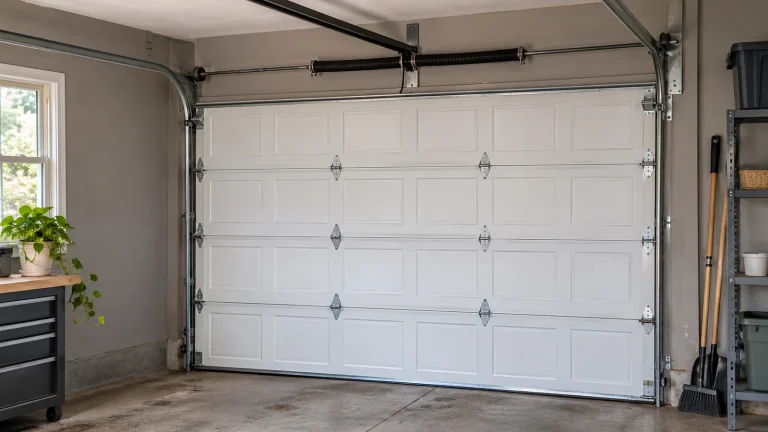
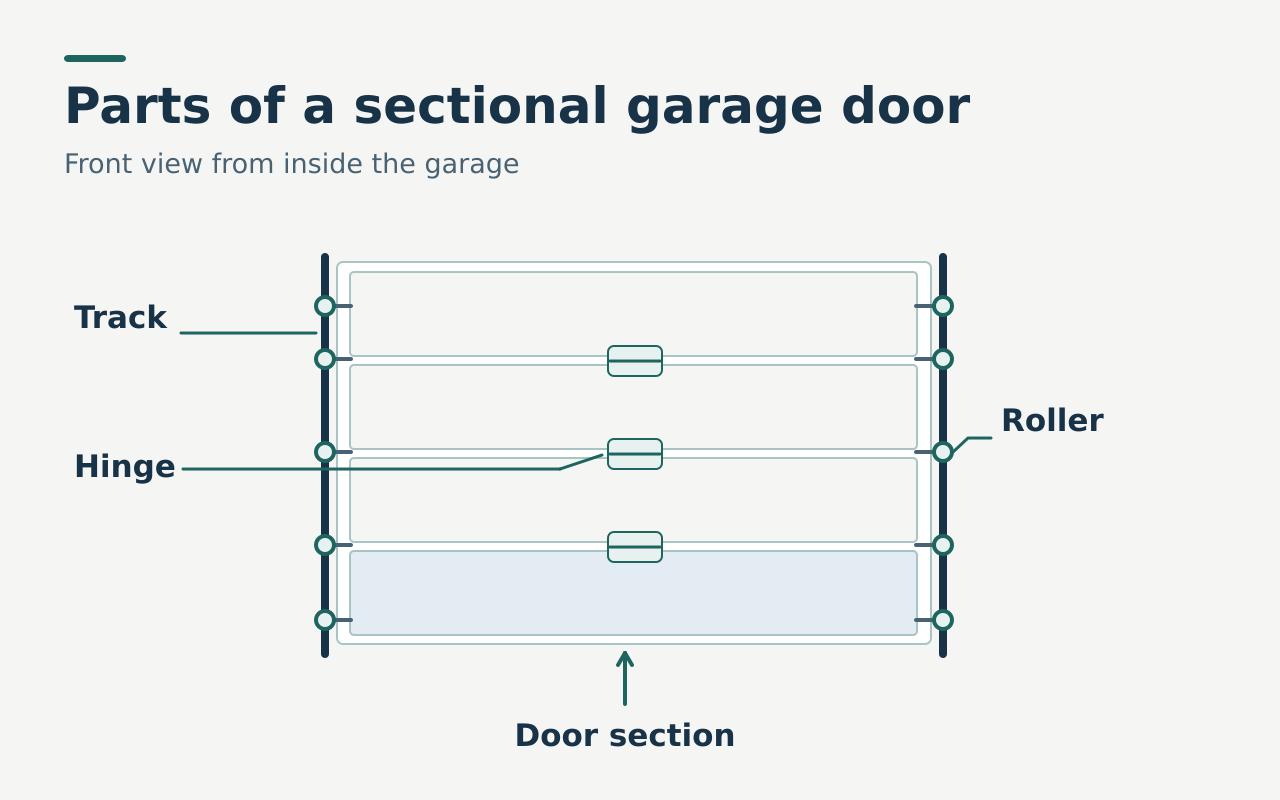
A typical sectional door is made of several full-width horizontal sections. Hinges join the sections so they can bend as the door travels through the curve overhead. Tracks are the metal channels on each side of the opening. Rollers are small wheels that ride inside the tracks, and each roller stem sits in a hinge or a roller bracket.
The counterbalance, meaning the spring system, carries most of the door’s weight. Lift cables connect the spring system to the door, and the bottom brackets near the lower corners are common cable attachment points. A bottom bracket can look like a plain piece of metal with a few screws, yet it can carry the full load of a spring through the cable. Leave it alone and point it out to the technician from a safe distance if it looks damaged.
The opener adds a motor and controls. It moves a door that is already supported and balanced. A motor that strains can be reacting to friction, a misaligned door, or a damaged counterbalance, so a technician should check the door and the opener as two separate parts of one system. If a quote lists a new motor without mentioning the condition of a visibly damaged door, ask what mechanical checks were done.
“Panel” can mean three things on an estimate: the whole horizontal section, the decorative shape pressed into it, or a small insert such as a window. Ask the person quoting to name the exact piece. A shallow dent in a decorative area and a crease where a hinge attaches are very different problems. A photo with the area circled settles the wording before a part is ordered.
Part names matter less than how the parts connect. A replacement roller must fit the track and the bracket at its exact position. A new section needs a compatible joint profile and attachment points. A new track must follow the path the door was built for. Matching a shape by eye tells you very little about how it will perform in the assembly.
For layouts and the difference between door hardware and opener hardware, see the garage door parts and hardware guide. The DASMA sectional door terminology sheet helps you match a trade name to the part on an estimate.
Which garage door repairs need urgent help?
Start with the door’s position. A closed door with a dent and nothing else wrong is an inconvenience. A door stuck partway open and leaning is a hazard. In the second case, keep people, pets, and vehicles away from both sides, use another entrance if you have one, and arrange urgent service.
Treat these as urgent:
- One side of the door is higher than the other.
- A roller is out of its track.
- A lift cable is loose, frayed, or hanging.
- You heard a loud bang and the door will not lift, with the opener running.
- The door is suspended above a vehicle or blocking the only exit.
When you call, describe the position in plain words: “The left side is higher than the right, and the door is stopped above the driveway.” Add whether a vehicle is inside, whether there is another exit, and whether anyone is trapped or hurt. If someone is trapped or in immediate danger, call 911. Tell everyone in the house about the restriction so nobody presses a remote while you are on the phone.
The first urgent visit often focuses on securing the door and making the area safe. Permanent repair can follow an inspection. Ask the dispatcher whether the visit is for stabilization, diagnosis, or an attempted repair, because that changes what you should plan for. A fully open door is still a mechanical hazard if a roller has left its channel or a cable looks loose. Keep the space underneath clear. The emergency garage door repair guide covers what to do while you wait.
What a garage door repair visit should cover
A useful visit starts with the history. Tell the technician when you noticed the symptom, which side it came from, and what changed recently: a new opener, a vehicle bump, wind damage, flooring work, or an added insulation kit. Describe only what you have already seen. Let the technician decide when it is safe to operate the door.
The inspection should cover the failed part and the parts it loads. If a center hinge tore loose, the technician needs to look at the metal that held it. If a roller scraped a bent track, the support behind the track and the nearby section also need attention. If the door changed shape after an impact, a quick look from the driveway is only the start.
You should leave with a written scope you can check. Compare these two lines:
- Weak: “Tune up door.”
- Useful: “Replace two worn rollers at the upper positions and inspect the left track support.”
The second tells you what failed, what is being done, and what is still to be confirmed.
Ask how the door will be checked at the end. For a door returned to service, expect a demonstration of normal travel and the opener’s reversing function and sensors, as described in the equipment manual. For a door left out of service, ask for the restriction in plain language and in writing. The garage door repair visit guide walks through diagnosis to handover.
How long a repair can take
Separate the time a technician spends at your home from the time your door is out of service. These are not the same. This table is planning guidance, not a promise. Ask each company for its own estimate.
| Situation | What usually happens | Typical shape of the timeline |
|---|---|---|
| Common part, in stock on the truck (roller, sensor, cable) | Diagnose and repair in one visit | Same visit |
| Part is not on the truck but is standard | Secure the door, order the part, return to install | Two visits, usually separated by days |
| Special-order section, special finish, or discontinued door | Confirm availability with the supplier before pricing | Two visits, with a longer wait |
| Impact damage with a shifted track or support | Inspect both sides and the mounting surface, then repair | One long visit or two |
| Door can only be secured on the first visit | Temporary stabilization, then a scheduled repair | Two visits |
Ask for three dates: the earliest the door can be left secure, the expected arrival of any special-order part, and the target for final testing. For a nonstandard finish or a discontinued section, ask when the supplier will confirm availability. Working time only starts once the part has arrived and the installer has checked it against your door.
A bent track on a door that is also scraping the floor is a good example. The technician needs to work out whether the track was damaged first or moved when the door came out of alignment. The scope should allow time to inspect both sides and verify smooth travel after repair. Ask who will tell you if the lead time changes. The repair timeline guide explains how to separate work time, parts time, and the period when you need another way into the garage.
Track and roller repairs
In a common layout, the vertical track follows the door opening, a curved section changes the direction of travel, and a horizontal section runs toward the back of the garage. The short rail near the ceiling that belongs to a trolley opener is a separate component.
A roller problem can show up as a wheel out of its channel, a rough or noisy wheel, or travel that catches at the same point each time. Track damage can look like a kink, a shifted joint, or a mount that has pulled away from its support. These can occur together. After a collision, a new roller alone leaves the wheel running over the same damaged route.
Ask the technician which part of the track is affected, what moved it, and whether the wall or ceiling support is sound. Rail shape must account for the curve, the support, and how the door moves across the whole opening.
Leave work that moves a track, replaces a roller on a loaded bracket, or tries to put a wheel back in its channel to a professional. Keep the door out of service when a wheel is out or the track looks displaced. As of November 2026, published national guides put roller work at about $100 to $250 and track repair or replacement at about $125 to $400, with a loose bracket costing far less than a new track. The garage door track guide explains vertical, curved, and horizontal sections.
Panel and full-section repairs
Some damage affects only the finish. Damage at an edge, around a hinge, or along the joint between sections can affect how the whole door travels. A technician should check neighboring sections and hardware whenever a crease reaches those areas.
A color match is easier to judge once you know the exact model, finish, pattern, and order date. A new painted section can look different from the others because the old finish has weathered. Take a photo of the whole door in daylight so you can judge how noticeable the difference might be. If the damaged section has windows, ask whether matching glazing and trim are in the quote.
A replacement section must match dimensions, joint shape, and attachment details. A section with different construction or a different window option can change the door’s weight and balance. Ask the technician what the manufacturer permits for your configuration. A promise that “the shop can make it fit” calls for documentation before you approve an order.
If no matching section is made, ask whether there is an approved repair for the damaged area, a documented compatible replacement, or a sound reason to quote a full door. The section replacement guide covers fit, finish, and availability.
Hinges, brackets, and mounting damage
A hinge joins two sections. On many doors, some hinges also hold roller stems. The number stamped on a hinge can identify its position in a given system, but only a technician who knows the door design can interpret it. Photograph markings only if you can do it without approaching loaded hardware.
A cracked hinge and a hinge that has pulled out of the section are different jobs. The second can leave a torn or enlarged mounting area. The technician needs to decide whether enough sound material remains and whether there is an approved way to restore the connection. Ask how the proposed repair deals with the underlying damage, not just the hinge.
Some brackets are part of the counterbalance. Bottom brackets often connect to lift cables, and spring-system brackets carry a different kind of load. Do not loosen or remove bolts, even on a closed door. A screw near a frayed cable is a detail for the technician.
When a quote includes replacing every hinge, ask which positions failed, what was inspected, and why a full set is proposed. The hinge replacement and compatibility guide explains position numbers and repair terms.
Damage after a vehicle hits the garage door
A bump at bumper height can leave visible damage low on the door and also shift the relationship between rollers, brackets, tracks, and sections. Damage near an edge deserves special attention because the roller and its mounts are close. Leave the door still after a hit until a technician has checked alignment and support.
Record the point of contact, the door’s position when it happened, and whether the vehicle is inside or out. If you can only photograph the outside safely, send that first, and include the whole opening plus a close view of the damage. Do not move a vehicle if doing so means going under a damaged door or running the opener. Tell the company about the access restriction when you call.
An impact assessment covers the affected section, its edges, both track paths, and the points where the system attaches to the building. If the wall framing looks damaged, ask who will evaluate it before a new door or track is attached, because a new door does not fix a damaged support. Ask for findings in writing. If you plan to file a claim, ask your insurer what documentation it needs before parts are removed. The post-impact assessment guide explains what to report.
When a garage door is off track
A door is off track when one or more rollers have left their channels. It may look angled in the opening or bowed to one side, or you may see a wheel or bracket sitting outside the track. A crooked door can have other serious causes, so treat any visible shift as a stop-use condition.
When wheels leave the guides, the door’s weight is unevenly supported. The opener may keep moving one part of the system while another part is caught. Stop sending commands, keep everyone out from under and around the door, and leave the emergency release alone. Stay clear even if the opener seems to hold the door in place, because a change in support can cause sudden movement.
The technician will look beyond the wheel. Possible causes include an impact, a damaged roller, a shifted track, a loose support, or a counterbalance problem. Ask what caused the wheel to leave and whether there was secondary damage. Getting the wheel back in place is only part of restoring a door whose path or support has changed.
Tell the scheduler if the door is suspended above a car, blocking the only exit, or open to the outside. The off-track garage door response guide lists the questions to ask before anyone comes out.
What common repair findings mean
Use this table to understand an explanation from a technician or a clue you can see safely. More than one problem can show up at once. An off-track roller and a kinked track can both result from a collision.
| Finding | What the technician may check | Homeowner or pro |
|---|---|---|
| Shallow dent on one section | Section edges, hardware attachment points, whether the finish is affected | Photograph from a clear position and ask for an assessment |
| Crease or tear near a hinge | Hinge mounting material, joint between adjoining sections | Stop use if the joint or support has shifted. Call a pro |
| Roller out of its channel | Tracks, brackets, counterbalance, any impact damage | Urgent pro visit. Keep clear |
| Bent or pulled-away track | Straightness, supports, mounting surface, adjacent hardware | Pro |
| Loose, frayed, or detached lift cable | Cable path and other parts under load | Stop use and call a pro |
| Door works but finish is deteriorating | Door material, coating, extent of corrosion | Follow the manual’s finish care on an otherwise sound door |
| Motor seems to work harder | Door balance, binding, opener operation | Pro diagnosis if movement changes or the cause is unclear |
A symptom that changes from one cycle to the next is worth describing. A door that moved normally until one corner caught on closing gives the technician a different starting point from one that grinds the whole way. Your job is to record what happened. Extra cycles on a damaged door can make the repair harder or put people at risk.
Homeowner work and professional repairs
Ask two questions. Does the job involve a part that helps carry, guide, or move the door? Does anything look damaged, loose, or out of position? If either answer is yes, have a trained technician look before you touch the hardware.
On a sound door, homeowner tasks include cleaning the outer surface as the manual directs, clearing clutter you can reach safely away from the opening, replacing a remote battery if the opener’s manual allows it, and gathering model information for the technician.
A technician should handle springs, lift cables, drums, bottom brackets, displaced tracks, and broken supports. Sections and hinges are part of the structure that holds the assembly together. Even a job that looks simple can change how the sections fold and how the weight is carried. Leave the opener to a technician if the motor unit or rail has shifted, wiring looks damaged, or you smell burning.
If a safety feature such as the reversing function fails on a door that is otherwise sound, stop automatic operation and arrange service. Do not disable it or work around it.
Repair a part, order a section, or replace the door?
| Option | Makes sense when | Watch for |
|---|---|---|
| Repair one part | Failures are limited, the rest of the door is sound, a compatible part is available | Hidden damage to the surface the part mounts to |
| Replace one section | Other sections, hardware, and the opening are sound, and a matching section is available | Color mismatch, weight and balance changes, long lead times |
| Replace the door | Several sections are damaged, a safety-critical part is unavailable, or work is needed across several systems | Whether the old opener, tracks, and springs are reused or replaced |
For example, a vehicle impact might produce two quotes: a special-order section from one company and a full door from another. Ask the section company what happens if hidden damage appears during service. Ask the replacement company which track, spring, and opener parts are included. Put both on one page and note when each written scope can change.
If you plan to sell the house, want a better seal, or want quieter movement, tell the contractor. These are separate goals from the repair. Keeping them separate helps you put upgrades on a later list without delaying a safe repair today.
Repair costs at a glance
These approximate U.S. ranges apply as of November 2026. They come from published national cost guides and combine parts and labor. They are not quotes. Local rates and door types move them up or down.
| Repair | Typical installed range | What moves it |
|---|---|---|
| Service call or diagnostic visit | $50 to $150 | Distance, time of day, whether credited to the repair |
| Roller set | $100 to $250 | Nylon or steel, door height |
| Track repair or replacement | $125 to $400 | Bent or broken, one side or both |
| Cable replacement | $100 to $400 | Whether springs or drums also need work |
| Spring replacement | $120 to $350 | Torsion or extension, one or a pair |
| Single section replacement | $250 to $1,000 | Matching availability, insulation, windows |
| Safety sensor repair | $100 to $250 | Alignment fix or new unit |
| Weekend or after-hours surcharge | $50 to $150 | Company policy, time of day |
For context, HomeAdvisor’s data puts the average garage door repair near $265, with most jobs between $155 and $379, while an average replacement runs about $1,223. This Old House’s 2026 guide describes a diagnostic visit at $50 to $75, often credited when you approve the work. Treat each figure as a way to notice an outlier, not as the price you should expect.
What pushes a quote up:
- A part that must be special-ordered, which adds a visit.
- Damage that reaches the mounting surface or the building.
- Two or three failures at once.
- After-hours service.
What can bring it down is fixing several parts in one visit instead of paying for separate appointments. If you are comparing offers, make sure each one ends in the same state. A quote that secures the door for the night and a quote that returns it to tested operation cover different outcomes. The garage door costs guide shows how to read the line items, and covers repairs, replacements, and installations.
How to choose a garage door repair company
Describe the problem the same way to each company: the door’s position, whether it is out of service, and whether you need to get a vehicle out. Ask who will do the work, how the visit is billed, and what experience the technician has with your type of door. Check any license your state or city requires with the issuing agency, and ask for proof of insurance.
Before you approve added work, ask the company to put the diagnosis and proposed repair in writing. A clear estimate says which parts are replaced, which are reused, and what could change the price. If a part has to be ordered, agree on how it is identified and who confirms availability. If the company uses subcontractors, ask who handles warranty requests.
If two companies give different diagnoses, ask each what evidence led to its conclusion. One might assume the metal behind a hinge is sound while the other saw a tear around the fasteners. A written difference like that tells you whether another inspection is worth it. Keep the door out of service while you decide if it has a safety fault.
The guide to choosing a repair company covers identity, insurance, estimates, second opinions, and accepting the work. The FTC’s home-improvement guidance explains how to check an estimate and avoid pressure to commit on the spot.
Prepare for service and accept the repair
Before the visit. Clear the sides of the garage only where it is safe to reach. Keep people out of the opening on the day. Tell the company if a car or stored items block an area you cannot safely clear. Find the door and opener model numbers on labels or in purchase records, and note which label you photographed. The opener’s label is on the motor unit. The door may carry a separate mark. If reading it means standing next to damaged hardware, wait for the technician.
When the technician starts. Confirm the approved work, what the crew will do if it finds hidden damage, and how it will report a change in price. Describe how the door behaved before the fault. If it always sealed at the floor and began leaving a gap after the impact, that goes in the job notes.
At handover. Ask to see the door move through full travel from a safe place. Ask the technician to demonstrate the reversing function and sensors, if your system has them. If the repair was limited, confirm what was inspected, what remains outside the scope, and which controls are safe to use. Keep the invoice with part numbers and warranty details.
After the visit. Note whether the original problem returns. If the door leans, catches, drops, or shows a loose cable, stop using it and call the company with the service date and the changed symptom. Let the company assess before you change any hardware or settings.
Four real-life repair scenarios
These are illustrations built from typical situations and the ranges above, not quotes from real companies.
Scenario 1: A noisy roller, door still level. The door grinds near the top corner, but it is level and every roller is still in its track. A technician can usually handle this in one visit. Worn rollers run about $100 to $250 as a set. Ask the technician to check the track and hinge at that position, since a damaged track will chew through new rollers. Ignoring the noise until a roller jumps the track turns a small job into an urgent one.
Scenario 2: A car backs into the lower corner. The bottom section is creased, the lower track looks pushed in, and the door sits slightly crooked. This is a stop-use situation. A section replacement runs about $250 to $1,000, a track repair $125 to $400, and the first visit may be only to secure the door. Photograph the damage from a safe position, tell your insurer before you approve permanent work, and ask each company whether the exact section is made. If it is not, ask for a replacement-door quote alongside the section quote and compare scopes.
Scenario 3: One side higher than the other. The right side of the door is hanging a few inches above the left, and the opener hums without lifting. The likely cause is a cable or spring problem, and the door may be unsupported. Do not press the remote again. Cable replacement runs about $100 to $400, spring replacement $120 to $350, and these often show up together. Call for urgent service, ask for a stabilization visit if the door is above a car, and ask the technician to inspect both sides. Replacing one cable and leaving the other worn can mean a second call.
Scenario 4: A dent that looks cosmetic. A shopping cart dents the middle of one section. The door runs normally. This one can wait for a normal appointment. Take photos in daylight, check that the dent is not at a hinge or an edge, and ask whether the section is worth replacing. Shallow dents in a decorative area are often a finish concern rather than a mechanical one, though a technician should confirm that no hardware attachment point is affected. If the quote for one section approaches the price of a new door, the decision table above applies.
Safety during garage door repair
When to call a pro. Stop operating a crooked, fallen, off-track, or unusually heavy door. Keep the opening clear. Leave springs, cables, drums, and bottom brackets in place. Call a trained garage door technician and verify any license required in your area.
Keep remotes and wall controls out of use while a door awaits service, and make sure everyone at home knows. Avoid standing near an overhead door that has lost support. Treat the space under the opening as off limits for storing tools, retrieving items, or moving a car until it is safe.
When you describe the problem by phone, be specific and factual: “I can see a gap between the top two sections after I bumped the door” is more useful than guessing at a broken part from across the garage. The technician can decide what equipment and crew are needed.
Never bypass a safety sensor or disable the auto-reverse feature to make a door close, even temporarily. If your opener’s protection feature fails during a test described in the manual, stop automatic operation and arrange service. Keep hands, feet, and body out of the door path whenever the door moves.
The DASMA residential inspection checklist shows the point where a basic inspection should stop and a trained technician should take over.
FAQ
Can a technician identify the damaged part from a photo?
Photos help a company identify the door style, see where an impact occurred, and bring likely parts. An on-site assessment is often still needed to check the material behind a hinge, a shifted support, or the rest of the door. Send photos taken from a safe position and ask whether the quote needs an in-person inspection.
How much does a typical garage door repair cost?
As of November 2026, most repairs fall between about $150 and $400, based on national cost guides. A roller or sensor job sits near the low end. A section replacement or a job with several failures can reach $1,000. Get a written quote that names the part and the work.
Is it safe to use the door if only one roller is out of the track?
No. A roller out of its channel means the door is no longer guided correctly, and the weight may be unevenly supported. Stop using the door, keep people clear, and call a technician. Do not try to push the roller back in.
What should I do if I rent the property?
Notify the owner or property manager and describe the door position, the access problem, and visible damage. Keep people clear if movement may be unsafe. Ask who can authorize repairs and how to reach them quickly if the door is stuck open. Follow your lease and local emergency contacts for urgent help.
Can a temporary repair stay in place while a part is ordered?
Ask the technician what the temporary work is meant to do. It may let the door be left secure but out of service. Get the restriction in writing, including whether the opener may be used and what to do if the door moves or its condition changes.
Should the technician give me the old parts?
Ask before work starts if you need old parts, photographs, or part numbers for a claim or records. The company can tell you whether it can return the parts. Let the technician handle loaded hardware.
Is a second visit covered under the original repair?
Check the written scope and warranty together. Ask whether the company charges to inspect a recurrence, how workmanship coverage applies, and what happens if the new symptom comes from a separate part. Give the company the service date and the date the symptom returned.
Next step
- From a safe place, write down the door’s position, the first symptom you noticed, and any recent impact or work.
- For an off-track, crooked, or visibly unsupported door, keep the area clear and call for urgent professional help.
- For planned work, ask for a written diagnosis and repair scope, and find out how the door will be checked at handover.